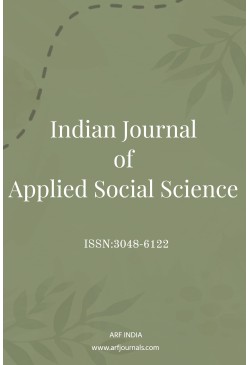
Indian Journal of Applied Social Science
Frequency :Bi-Annual
ISSN :3048-6122
Peer Reviewed Journal
Frequency :Bi-Annual
ISSN :3048-6122
Peer Reviewed Journal
INDIAN JOURNAL OF APPLIED SOCIAL SCIENCE: is a double-blind peer reviewed bi-annual journal of the theoretical and applied areas in Social Sciences.
IJASS: provides a unique forum for theoretical debates and empirical analyses that move away from narrow disciplinary focus. It is committed to comparative research and articles that speak to cases beyond the traditional concerns of area and single-country studies. IJASS strongly encourages trans disciplinary analysis of contemporary and historical social change in South Asia by offering a meeting space for international scholars across the social sciences, including: art and archaeology, anthropology, cultural studies, criminology, development studies, education, economics, geography, history, human rights, international relations, law, linguistics, political science, psychology, social policy, social work, sociology, women studies and related fields. IJASS publishes peer-reviewed research articles, special thematic issues, and shorter symposiums. IJASS also publishes book reviews, research notes, and short essays on South Asia societies.
IJASS INSTRUCTIONS FOR AUTHORS
Submission of a paper implies that it has not been published previously, that it is not under consideration for publication elsewhere, and that if accepted it will not be published elsewhere in the same form, in English or in any other language, without the written consent of the publisher.
All papers submitted to the journal will be reviewed through a double-blind peer-reviewed process (1–3 reviewers).
All papers should be typewritten in Word (Times New Roman) and emailed to Editor-in-Chief:- DR. MINAKETAN BAG, School of Anthropology, GM University, Amruta Vihar, Sambalpur, Odisha - 768004, India, e-mail: eicijass@gmail.com
The maximum length of the article in double space with 12 pt font size is 30 pages including graphs, tables, and others.
The title page should include the article’s title and the author’s name and affiliation. Address details should include telephone number and email.
The second page should contain the title of the paper, abstract, Keywords, and JEL classification codes. The abstract should not exceed 150 words (100 – 150 words). JEL classification codes are up to three, and Keywords are up to five.
The text of the article should include section headings (designated by Roman numerals – I, II. III,…), and subsection headings (Arabic numbers – 1, 2, 3,…). References should be given in the following form:
Shleifer, A. and R. W. Vishny. 2003. “Stock Market Driven Acquisitions,” Journal of Financial Economics, 70(3), 295-311.
Do not use any footnotes, rather put all notes immediately following the article. Numbering should be done using the standard Arabic number system (1, 2, 3, etc.)
References should follow the Notes section at the end of the article.
Tables and graphs should follow the References section. Tables should be numbered consecutively and given a suitable caption and each table typed on a separate sheet.
Download PDF