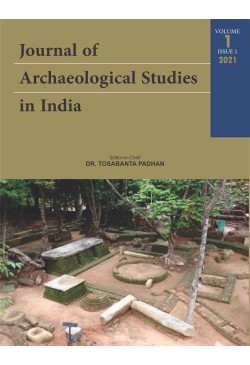
Journal of Archaeological Studies in India
Frequency :Bi-Annual
ISSN :2582-9831
Peer Reviewed Journal
Frequency :Bi-Annual
ISSN :2582-9831
Peer Reviewed Journal
Recent Archaeological Investigation in Jalandhar District of Punjab: Special Reference to Black Slipped Ware Sites
Pottery is a valuable tool for understanding the lifestyle of any civilization and culture. A gradual development of pottery traditions is seen in Northern India. In these pottery traditions, information about settlements using Black Slip Ware has been found from time to time in Punjab. In the present investigation, evidence of settlements by people who used this (BSW) pottery type has been found on a large scale in the Jalandhar district of Punjab. In this research paper, an attempt has been made to throw light on the development and expansion of these settlements in Jalandhar district. Through FT-IR spectra, an attempt was made to understand the firing technology of Black Slipped Ware pottery.
Keywords: Kali Bein, Safed Bein, BSW, Painted grey ware.
Rahul Kumar 2025. Settlement Pattern and Resource Adaptation of Hakra Communities in Haryana. Journal of Archaeological Studies in India, 4: 2, pp. 99-109. https://doi.org/10.47509/JASI.2025.v04i02.01
Technology, Craftsmanship, and Decorative Traditions of Palanquins in Sri Lanka: A Historical Review
This review examines the technological evolution, craftsmanship, and decorative traditions associated with palanquins in Sri Lanka, situating the artefact within broader socio-cultural and political histories of mobility. The palanquin functioned not merely as a mode of elite transport but as a symbol of status, ritual authority, and aesthetic expression. While previous scholarship has primarily focused on royal processions, caste-based labor systems, and the socio-political functions of elite conveyances, detailed studies on construction technology, material selection, and decorative conventions remain limited. This review synthesizes historical chronicles, colonial-era descriptions, ethnographic observations, and material evidence preserved in museums and temple collections to provide an integrated understanding of the artefact’s technological and artistic significance.
Key research questions guiding this review include: How did the technological construction of palanquins evolve over time in Sri Lanka? What woodworking, joinery, and metalworking traditions informed their manufacture? How did aesthetic elements such as lacquer work, carving, textiles, and metal fittings express social hierarchy and regional craftsmanship? What socio-religious conventions shaped their ceremonial uses? The study adopts a qualitative review methodology, analyzing textual sources, visual archives, and surviving specimens to reconstruct patterns of technological practice and symbolic meaning.
Findings indicate that palanquin design in Sri Lanka represented a confluence of local craft traditions, imported stylistic influences from South Asia, and evolving elite tastes. The integration of indigenous woods, lacquer traditions, metal embossing, and symbolic motifs reveals the palanquin as a mobile canvas of artistic expression and technical skill. By consolidating dispersed historical data, this review contributes a comprehensive account of Sri Lankan palanquin traditions and highlights their value as material heritage reflecting engineering ingenuity, artistic creativity, and social identity.
Keywords: Palanquins, Sri Lankan material culture, Craftsmanship and decorative arts, Mobility and elite transport, Woodcraft and metalwork traditions.
Mandaramnuwara Chandananda & Priyangika Lakmali, P.G. 2025. Technology, Craftsmanship, and Decorative Traditions of Palanquins in Sri Lanka: A Historical Review. Journal of Archaeological Studies in India, 4: 2, pp. 111-126. https://doi.org/10.47509/JASI.2025.v04i02.02
Monastic Networks, Cultural Transmission, and Spiritual Lineage: Exploring the Tibetan Buddhist Connections and Legacy of Pemayangtse and Tawang Monasteries
This study explores the profound relationships between Tibetan Buddhist monasteries in the Himalayan region, focusing on the Mindröling-Pemayangtse and Drepung-Tawang monastic affiliations. Through a nuanced examination of their historical development, cultural exchange, and spiritual practices, this research reveals the pivotal role these monasteries have played in shaping the region’s cultural, spiritual, and intellectual landscape. By investigating the transmission of doctrine, propagation of religious teachings, and artistic traditions, this study highlights the enduring legacy of Tibetan Buddhism in the Himalayas. Drawing on a rich array of primary and secondary sources, supplemented by archival materials and extensive fieldwork conducted at Tawang and Pemayangtse monasteries, this research provides a comprehensive understanding of the complex dynamics between Tibetan Buddhist institutions. The findings underscore the significance of spiritual kinship and cultural exchange in fostering a deep sense of continuity and shared heritage among these monasteries. This study contributes to a deeper understanding of the role of Buddhist monasteries in preserving cultural heritage, promoting spiritual and intellectual exchange, and shaping the identity of the Himalayan region. Ultimately, this research demonstrates the transformative impact of spiritual and cultural exchange on the development of Buddhist monasteries in the Himalayas. Looking forward, this study proposes a futuristic approach that integrates cultural preservation, sustainable tourism, and community engagement, offering a roadmap for the long-term conservation and revitalization of these sacred institutions, while also promoting intergenerational knowledge transmission and cultural continuity in the face of globalization and climate change.
Keywords: Mindröling, Pemayangtse, Drepung, Tawang, Nyingma, Gelug.
Krishna Kumar Sharma 2025. Monastic Networks, Cultural Transmission, and Spiritual Lineage: Exploring the Tibetan Buddhist Connections and Legacy of Pemayangtse and Tawang Monasteries. Journal of Archaeological Studies in India, 4: 2, pp. 127-143. https://doi.org/10.47509/JASI.2025.v04i02.03
Pliestocene Specie Displacement of Elephus and Stegodonts in the Indian Subcontinent
The paper explores relationship between changing environments, vegetation and climates with respect to species displacement. It examines the emergence of new species in areas not native to them and they displace the preexisting similar families species by competing with them for resources and space. A compartitive study has been done of the isotope ratios between Indian localities of Siwaliks, Narmada and Manjra valleys and the Irrawaddy localities to understand specie displacement. Irrawaddy values for carbon are in the range ?13C = -6.9‰ to -0.8‰ and for oxygen the are ?18O = -6.9‰ to -5.5‰, whereas the same taxa in Siwaliks has given the range for carbon ?13C = - 2.2‰ to -1.2‰ and for oxygen ?18O = -6.0‰ to -5.0‰
The Late Pleistocene saw the dominance of the Elephas and the eventual dying out of the other grazer proboscideans such as the Stegodons. The dominating proboscideans in the Late Pliocene to Early Pleistocene were the Stegodonts, particularly Stegodon insignis, Stegodon orientalis, Archidiskodon planifrons, Elephas hysudricus in the Mainland regions of Asia. In Java species such as Stegoloxodon indonesicus, Sinomastodon bumiajuensis, Stegodon trignocephalus, Elephas hysudridcus were thriving. The ?13C values generated from this taxa are slightly more positive and is in the range (-7.8‰ to 1.2‰). This shift is indicative of mixed diets and rise of specialized grazers, even then these values are not of pure C4 grazers. An increase in the ?18O values is also seen, this is expected as the aridity increased the values recorded became higher in the range of (-6.9‰ to -2.2‰).
Keywords: Isotopes, Proboscideans, Megafaunal Extinctions.
Sonika Sandhu 2025. Pliestocene Specie Displacement of Elephus and Stegodonts in the Indian Subcontinent. Journal of Archaeological Studies in India, 4: 2, pp. 145-157. https://doi.org/10.47509/JASI.2025.v04i02.04
Rediscovering Negombo Fort, Sri Lanka: Integrating LiDAR and Historical Dutch Maps to Reconstruct a Colonial Landscape Altered by Time
This study investigates the surviving spatial configuration of the Negombo Fort, a major colonial fortification on the western coast of Sri Lanka, through the integration of airborne LiDAR data and a georeferenced eighteenth-century Dutch plan. A Digital Elevation Model (DEM) (0.5 m) generated from classified “.las” LiDAR data reveals subtle yet distinct topographic signatures corresponding to the fort’s eastern defensive structures, including the northern and southern bastions and the connecting rampart, all of which retain their original geometric forms despite extensive modern development. Georeferencing the 18th-century plan against the LiDAR- erived DEM confirms the spatial correspondence of these features and further identifies a previously unrecognised mound representing the southern bastion on the fort’s western side, an element not documented in earlier studies. The analysis also demonstrates the partial survival of the moat system, now integrated into the contemporary lagoon. These results highlight the value of combining LiDAR with historical cartography to reconstruct heavily altered colonial landscapes. The study demonstrates that LiDAR, traditionally used in non-urban archaeological contexts, is equally effective in dense urban environments, offering a powerful methodological framework for identifying concealed or altered archaeological features. The findings refine existing interpretations of the Negombo Fort and emphasise the utility of integrative spatial approaches in urban archaeological research.
Keywords: DEM, Dutch, Georeferencing, Hillshade, LiDAR, Negombo.
M.A. Samandika Manoj Madduma Arachchi 2025. Rediscovering Negombo fort, Sri Lanka: Integrating LiDAR and Historical Dutch Maps to Reconstruct a Colonial Landscape Altered by time. Journal of Archaeological Studies in India, 4: 2, pp. 159-173. https://doi.org/10.47509/JASI.2025.v04i02.05
Geoarchaeology of Cuddapah Basin and Eastern Peneplains in Peninsular India: An Oasis of Prehistoric Cultural Progression
The Cuddapah Basin Region (CBR) of Andhra Pradesh is unique landscape in peninsular India, typified by different geological formations and subsequent geomorphological processes during the Pleistocene and Holocene Periods. Limestone caves, caverns, rock shelters, riverine deposits and floodplains of the region gained prominence due to the recovery of data related to prehistoric cultures, animal fossils, volcanic ash and sand dunes. These data systems were collected through explorations and excavations and have been subjected to geoarchaeological, palaeoenvironment, rock art and chronometric studies by various researchers of different academic fields and surveys. During the last one and half centuries (1863-2024) prehistoric studies have identified 270 culture bearing sites in the region, characterised as surface stations, caves and rock shelters, yielded the evidences of lithic tools belong to Palaeolithic (Lower, Middle and Upper), Mesolithic, Neolithic and Megalithic cultures and their respective associated cultural and non-cultural objects of evidencs. Some of these sites have preserved animal fossils, particularly in limestone caves, rock art at ceilings and walls of rock shelters, volcanic ash (Youngest Toba Tuff) in riverine and lacustrine substratums and sand dunes as surface deposits. These fossils, ash and sand dunes are of great significance in calibration of absolute chronology and environmental reconstruction of CBR. Scientific methods like Carbon-14, OSL, TL and XRF are deployed and cross- dated to MIS timeframes of Pleistocene and Holocene periods, and delineated typo-technological cultural progression of the region based on archaeological evidences and geographical distribution. Review and compilation of these studies and sites has resulted in deduction of possible paths of prehistoric migration from coast to inland and thereafter into the CB in the context of out of Africa south coastal migration of anatomically advanced hominines. The data are presented in various tabular forms (3) together with appendix, which provide site specific data for further studies.
Keywords: Palaeolithic, Limestone caves, Rock shelters, Youngest Toba Tuff, Animal fossils, Palaeoclimate, Palaeoenvironment.
P. Vijaya Prakash 2025. Geoarchaeology of Cuddapah Basin and Eastern Peneplains in Peninsular India: An Oasis of Prehistoric Cultural Progression. Journal of Archaeological Studies in India, 4: 2, pp. 175-200. https://doi.org/10.47509/JASI.2025.v04i02.06
Middle Palaeoliths in a Microlithic Landscape: Analyzing Tool Assemblage on Rocky Outcrops in the Upper Baitarani Valley, Keonjhar District, Odisha
This study presents the results of an exploration of the Upper Baitarani valley in Keonjhar district, Odisha, with particular reference to the semi-elevated and elevated granitic rock outcrops in the Musakhari localities of the Patana block. Notably, the entire Musakhari region and surrounding areas show numerous microlithic sites, with no evidence of earlier cultural materials; however, only the Musakhari locality-II site shows Middle Palaeolithic, late/Upper Palaeolithic, and microlithic tool assemblages. The most interesting aspect of the lithic assemblage recovered from the Musakhari-II site is the predominance of Levallois elements, including prepared and discoidal cores, flakes, points, scrapers of various types, and a very small number of parallel-sided and elongated blades and bladelets. The lithic assemblage also includes a microlithic tool assemblage comprising cores, flakes, and numerous finished tools. The artefacts recovered from the site are made from quartzite, dolerite, and silicified cryptocrystalline rocks, which were imported from the nearest hills and riverbeds as large blocks, pebbles, and cobbles. The raw materials were most probably imported from the Baitarani river valley, about 10 kilometres north of the Musakhari site, and were also available on the Sita River, a tributary of the Baitarani, situated nearly 3 kilometres from the site. The assemblage recovered from the site is predominantly flake-based, and the flakes are made exclusively from locally available rock sources. In terms of raw material use for tool production and other aspects, the studied assemblage markedly differs from sites with large-flake tools widely distributed in other parts of Odisha, where artefacts are predominantly made from medium- to fine-grained quartzite. However, in the upper Baitarani valley, dolerite is utilised alongside quartzite, which is abundantly available in the northern highlands and within extensive dolerite dykes. This highlights the variability of lithic assemblages in the region.
Keywords: Rock-Outcrop, Levallois, Prepared Core, Flakes, Crypto-crystalline, Discoidal Cores, Middle Palaeolithic and Microliths, Holocene, etc.
Nishikanta Dwibedi 2025. Middle Palaeoliths in a Microlithic Landscape: Analyzing Tool Assemblage on Rocky Outcrops in the Upper Baitarani Valley, Keonjhar District, Odisha. Journal of Archaeological Studies in India, 4: 2, pp. 201-219. https://doi.org/10.47509/JASI.2025.v04i02.07