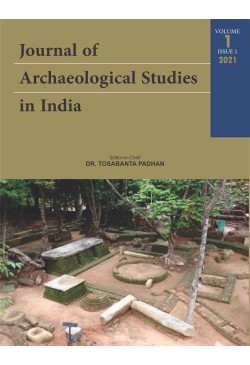
Journal of Archaeological Studies in India
Frequency :Bi-Annual
ISSN :2582-9831
Peer Reviewed Journal
Frequency :Bi-Annual
ISSN :2582-9831
Peer Reviewed Journal
Report of a Recent Archaeological Exploration at Agiabir, Mirzapur District, Uttar Pradesh
This article provides an overview of a recent archaeological exploration conducted at Agiabir (Lat. 25° 13’ 52” N, long. 82° 38’ 41” E), located in the Mirzapur District of Uttar Pradesh. This exploration was carried out by a team of post-graduate students of the session of 2022-23 from the Department of Ancient Indian History, Culture and Archaeology of Banaras Hindu University in the month of June 2024, under the guidance of faculty members of the concerned institution. The exploration at this site yielded several significant surface artifacts, enhancing the site’s status as a prehistoric to early-historic location. Among the notable findings were various types of potsherds, terracotta objects, stone implements and iron slag. This paper aims to offer a detailed analysis of these artifacts, shedding light on their relevance and implications for our understanding of Agiabir site’s historical and archaeological context on the basis of recent exploration.
Keywords: Exploration, Ring-well, Agiabir, Potsherds, Terracotta, Iron Slag, NBPW.
Mukant Bishwas & Dr. Prabhakar Upadhyay 2025. Report of a Recent Archaeological Exploration at Agiabir, Mirzapur District, Uttar Pradesh. Journal of Archaeological Studies in India, 4: 1, pp. 1-21. https://doi.org/10.47509/JASI.2025.v04i01.01
Extinction of Past Proboscideans from the Indian Subcontinent- Possible Reasons and Theories
In this study, stable Carbon and Oxygen isotope analysis was carried out on the proboscidean tooth enamel samples from the DC collection available at Deccan College Post-Graduation and Research Institute, Pune. The collection comprises of various specimens of the Proboscidean community discovered from various fossil localities in the Siwaliks, Central Narmada Valley and the Manjra river valley. The specimens cover the periods from late Pliocene to upper Pleistocene. The basic aim of this work was to reconstruct the interactions and relationships between environment change in the past, and the appearance and disappearance of various proboscideans associated. The idea was to gather an understanding of how the changing landscape actually affected the proboscidean populations and caused their disappearance in some regions whereas in certain other areas they continued to thrive and be present until recently.
Keywords: Isotopes, Proboscideans, Megafaunal Extinctions.
Sonika Sandhu 2025. Extinction of Past Proboscideans from the Indian Subcontinent- Possible Reasons and Theories. Journal of Archaeological Studies in India, 4: 1, pp. 23-36. https://doi.org/10.47509/JASI.2025.v04i01.02
Exploring Mesolithic Cultural Remains: Evidence from Palasponga Region, Keonjhar, Odisha
The emergence of small and highly distinctive stone tools found throughout the Mesolithic is a defining feature of the period. A small-sized stone tool of different shapes, which could be a haft on a wood can be used as a spear, arrow, sickle, or saw, indicates a foraging economy focused on small game hunting or fishing. The cultural period is quite long, with a chronological range of approximately 10,000 B.C.E. to 8,000 B.C.E. This survey was conducted in the vicinity of the Palasponga region (21°46?55” N latitude and 85°33’59” E longitude) in the Keonjhar district of Odisha. The location is situated on the right bank of the Ardei River, which is a tributary of the Baitarani River. This densely forested region is an extension of the Chhotanagpur plateau. Through a lot of effort, the investigation produced nine prehistoric sites and six hundred and one lithic items from several cultural periods, including the Lower, Middle and Upper Palaeolithic, Microlithic and Neolithic. The survey in the area was conducted during the late winter season of February 2020. The available prehistoric evidence is limited only to the stone artifacts, and these collected materials indicates the human habitation in this area from the Lower Palaeolithic culture of the Middle Pleistocene epoch to the Neolithic period of the Holocene epoch.
Keywords: Chronological, Habitation, Mesolithic, Typology, Technology.
Jayashree Prusty & Subrat Kumar Nayak 2025. Exploring Mesolithic Cultural Remains: Evidence from Palasponga Region, Keonjhar, Odisha. Journal of Archaeological Studies in India, 4: 1, pp. 37-48. https://doi.org/10.47509/JASI.2025.v04i01.03
Derivative Archaeology: Archaeological theory, Praxis, and us as Agency
Archaeology as a domain is maturing in different regions at different pace with diverse challenges in production of knowledge. Our interpretation, conditioned by our individual positions play a pivotal role in this process. During my recent fieldwork in Gujarat, India, as we visited excavated sites (many reburied), several occasions presented cases for propensity.
The first is, how we continue to evolve as humans and as archaeologists. The seemingly regular practices of discarding the redundant excavated material, marking the artifacts with provenance information and restorations of excavated structures appear intriguing and perplexing. The decades old excavation/ exploration reports pose a challenge of reading those in a ‘historical’ framework. One of the sites hosts and protects a location occupied by the lead excavator during excavation seasons. The presentiment of a site acquiring veneration in the midst of a profane context is irresistible and introspecting the causes for this transformation becomes imperative.
The other predisposition is about how the site continues to be a function of society around it throughout the time. For the site, the processes of excavation, discard, and back-filling themselves seem to remodel it. It continues to be ‘used’ and also ‘misused’ from an academic and heritage management perspectives. However, both use and misuse cases are in response to need or incomprehension of respective times. The excavated sites thus present themselves as derivatives of previous academic exercises and societal functions. We, as laypeople and as archaeologists, thus continue to experience the deja-vu every time we analyse the site.
Keywords: Derivative, Interpretation, Contexts, Tendency.
Pallavee Gokhale 2025. Derivative Archaeology: Archaeological theory, Praxis, and us as Agency. Journal of Archaeological Studies in India, 4: 1, pp. 49-60. https://doi.org/10.47509/JASI.2025.v04i01.04
Hunting The Bison: Trail of Bisons in Prehistoric Rock-art of India
Bison is a commonly depicted bovine in prehistoric Rock-art of India. Genomic studies have revealed its pattern and manner of spread in India and from here to neighboring regions, along with contribution of Indian Gaur in genetic constitution of other bovine species, especially Mithun (Bos frontalis). Apparently, this scenario can be made more nuanced by collating the genetical picture with that artistically narrated in Prehistoric Rock-art. In this paper, an attempt shall be made to comprehend the differentiated occurrences of bison in Indian Rock-art, its multifaceted roles in prehistoric hunting-foraging societies, and supplement further material to the complex genetic prehistory of movement of Indian Bison, through a comparative assessment of four major prehistoric sites of Rock-art in India. The study would also try to exhibit the epi-genetic factors that affected Bison biology, as strictly gleaned from Rock-art evidence.
Keywords: Bison, Bovine, Rock-art, Bhimbetka, Prehistoric period, Hazaribagh, Isko, Kupgallu.
Arindam Chaturvedi 2025. Hunting The Bison: Trail of Bisons in Prehistoric Rock-art of India. Journal of Archaeological Studies in India, 4: 1, pp. 61-81. https://doi.org/10.47509/JASI.2025.v04i01.05
Settlement Pattern and Resource Adaptation of Hakra Communities in Haryana
The Hakra cultural horizon represents one of the earliest phases of protohistoric development in the north-western Indian subcontinent and constitutes the formative stage preceding the emergence of the Harappan Civilization. Initially identified through extensive surveys along the dry course of the Hakra River in the Cholistan Desert, this cultural tradition is characterized by distinctive ceramic assemblages and dispersed settlements closely associated with palaeochannel systems (Mughal, 1990). Subsequent archaeological investigations have revealed an eastern extension of this tradition into the Upper Sarasvati–Drishadvati basin of present-day Haryana, where excavations at sites such as Kunal, Bhirrana, Farmana, and Girawad indicate the presence of early agro-pastoral communities adapting to a fertile alluvial environment (Parmar & Shinde, 2011).
Comparative analysis suggests that while Cholistan Hakra settlements exhibit a higher proportion of temporary or semi-mobile camps adapted to semi-arid conditions, the Haryana sites demonstrate increasing sedentism supported by stable water sources, cultivable soils, and access to raw materials from the Aravalli hinterland (Garge, 2014). Archaeobotanical evidence further points to diversified subsistence strategies, including the cultivation of drought-resistant millets alongside other crops, reflecting flexible agricultural adaptation to regional ecological settings (Pokharia et al., 2014).
This study examines the settlement distribution and resource-use strategies of Hakra communities in Haryana in comparison with the Cholistan type-region, highlighting how environmental variability shaped early cultural trajectories and contributed to the transition toward more organized Early Harappan socio-economic systems.
Keywords: Hakra Culture, Eastern Hakra Phase, Protohistory of Haryana, Settlement Pattern; Ghaggar–Sarasvati Basin, Saraswati–Drishadvati System, Resource Adaptation, Agro-pastoral Economy; Palaeochannel Settlement, Early Agricultural Communities, Upper Sarasvati Basin; Cholistan Desert, Environmental Archaeology, Indus Pre-Urban Phase, Early Harappan Transition.
Vineet Kumar & Ritu 2025. Settlement Pattern and Resource Adaptation of Hakra Communities in Haryana. Journal of Archaeological Studies in India, 4: 1, pp. 83-97. https://doi.org/10.47509/JASI.2025.v04i01.06