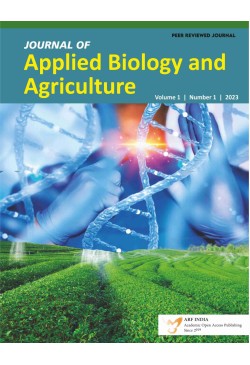
JABAJournal of Applied Biology and Agriculture
Peer Reviewed Journal
Peer Reviewed Journal
AI EXPANSION IN AGRICULTURE TRENDS, APPLICATIONS AND CHALLENGES
Agricultural production is a high-dimensional, data-rich domain where decision-making involves optimizing sowing windows, irrigation scheduling, nutrient management, and pest control under uncertain biophysical and economic conditions. Artificial Intelligence (AI) offers algorithmic frameworks capable of synthesizing heterogeneous datasets—ranging from multispectral/hyperspectral satellite imagery (e.g., Sentinel-2, RISAT-1A), UAV- cquired high-resolution imagery, in-field IoT sensor data, and weather reanalyses to market intelligence—into actionable, site-specific recommendations.
Machine Learning (ML) algorithms such as Random Forests (RF) and Gradient Boosted Machines (XGBoost) have demonstrated robustness to mixed data types and missing values, outperforming linear baselines in yield estimation (e.g., maize, wheat, potato; RMSE reductions up to 14%). Deep Learning (DL) architectures—including Convolutional Neural Networks (CNNs) for vision-based disease detection and Transformer-based multimodal fusion models—enable high-accuracy classification and segmentation (e.g., PlantVillage CNN achieving >98% accuracy across 26 diseases; UAV-MobileNetV2 pipeline detecting cashew anthracnose with 95% accuracy). Temporal models (LSTM, Bi-LSTM) improve yield forecasting by exploiting sequential dependencies in weather–vegetation index time series. Reinforcement Learning (RL) frameworks have outperformed rule- ased control in irrigation scheduling within APSIM simulations.
Field deployments show quantifiable impacts: AI-guided smart sprayers reduced herbicide usage by ~90% in Florida strawberry plots; drone-based nutrient/pesticide application in Karnataka ragi and tur dal achieved 90% water savings and yield gains of 5–10%; satellite-guided advisory systems (Cropin + World Bank) increased farm incomes by up to 37%. FAO-led platforms such as WaPOR and ASIS operationalize AI for continental-scale water productivity monitoring and drought early warning.
Persistent challenges include spatial–temporal domain shift in model generalization, smallholder access constraints, and the environmental footprint of large-scale model training. Addressing these demands localized model calibration, low-cost edge ML deployments, explainable AI frameworks, and governance structures ensuring farmer data ownership. AI’s integration with agronomic expertise and institutional support can enable scalable, sustainable intensification while mitigating environmental impacts.
Keyword: AI, IoT, Machine Learning, Precision Agriculture, Drones, Automation.
Dhiraj Madhav Kadam, Nishigandha Satish Chavan, Dr. Pravin Himmatrao Vaidya and Pritam Omprakash Bhutada (2025). AI Expansion in Agriculture Trends, Applications and Challenges. Journal of Applied Biology and Agriculture. 2(1-2), 1-15.
IMPACT ASSESSMENT IN SERICULTURE: A COMPREHENSIVE REVIEW
This review explores the significance of impact assessment (IA) in sericulture, focusing on its socio-economic, and technological dimensions. By synthesizing methodologies such as cost-benefit analysis, adoption indices, and regression models, the study demonstrates how sericulture enhances rural livelihoods while facing challenges like high costs and low technology uptake. Our findings demonstrate that sericulture significantly contributes to rural employment, income generation, and women’s empowerment, particularly in developing regions. However, the sector faces persistent challenges including market volatility, resource constraints, and uneven technology adoption. The review underscores the importance of training, extension services, and policy support in bridging these gaps. Emerging technologies like AI, GIS, and big data analytics offer promising avenues for refining IA precision, while climate-resilient practices and participatory approaches are essential for long-term sustainability. The review concludes with recommendations for strengthening impact assessment frameworks through enhanced stakeholder engagement, policy support, and the adoption of climate-resilient practices. These measures are essential for maximizing sericulture’s potential as a sustainable agro-industry while addressing current limitations in assessment implementation and technology transfer.
Keywords: Impact assessment (IA), Sericulture, Socio-Economic impact, Technology adoption, Statistical tools.
Manjunatha G R, Rajeev B N & Veeranagappa P. (2025). Impact Assessment in Sericulture: A Comprehensive Review. Journal of Applied Biology and Agriculture. 2(1-2), 17-34.
SUSTAINABLE SOCIOECONOMIC DEVELOPMENT VIA MANGO FRUIT VALUE CHAIN: A COMPREHENSIVE REVIEW ON KENYA AND INDIA
The mango fruit value chain plays an important role in driving sustainable socioeconomic development in both emerging and developing economies. This review explores the value chain of two major mango-fruit-producing countries Kenya and India, to assess its contribution to inclusive growth, rural livelihoods and environmental sustainability. By analysing each stage of the mango fruit value chain, from production and processing to marketing and export, the review identified shared challenges and context-specific opportunities for value addition, market access and smallholder farmer empowerment. The study highlighted the role of gender inclusivity, climate- silience agricultural practices and public-private partnerships in enhancing value chain performance. Makueni which is the highest mango fruit producing county in Kenya relies on three business models in distributing their mango fruits while India is identified to utilise a well-structured value chain with strong institutional support however, both countries export a share of 2.1% of their mango fruit production. Drawing on comparative insights, the review underscores innovative practices in India’s structured value chain to have potential that can inform strategies in Kenya, while also showcasing Kenya’s emerging initiatives that promote sustainability and resilience. The review concludes with recommendations to policymakers, development agencies and mango fruit enterprise stakeholders that can leverage mango sector as a strategic pathway toward sustainable development in both countries.
Keywords: Mango fruit, Value Chain Mapping, Socioeconomic, Sustainability.
Catherine Mueni Peter, Supriya & Mwenjeri Prateek Kumar (2025). Sustainable Socioeconomic Development Via Mango Fruit Value Chain: A Comprehensive Review on Kenya and India. Journal of Applied Biology and Agriculture. 2(1-2), 35-58.
WATER USE EFFICIENCY AND SMART IRRIGATION SCHEDULING
Water scarcity is an escalating global challenge, with agriculture consuming ~80% of freshwater withdrawals, primarily for irrigation. Conventional methods—such as flood and furrow irrigation—are inefficient, with only 35-40% of withdrawn water effectively used by crops. Field application efficiencies typically average ~60% for surface irrigation and ~75% for overhead sprinklers, compared to ~90% for drip (micro-irrigation) systems. Smart irrigation scheduling integrates high-efficiency delivery methods with data-driven control, applying water in the right amount, at the right time, and directly to the root zone to minimize evaporation, runoff, and deep percolation losses.
Modern smart scheduling systems employ soil moisture sensors, weather stations, IoT connectivity, and decision support algorithms (including AI-based controllers) to determine optimal irrigation timing and volume. Approaches include soil-moisture-based, evapotranspiration (ET)-based, and plant-based triggers, often combined with predictive models such as FAO-56 Penman–Monteith. Field studies consistently report substantial benefits: IoT-enabled drip irrigation in lettuce reduced water use by 28.8% and increased crop water productivity by 52.5%, while a DSS-guided lemon orchard in Pakistan saved ~50% water and achieved 35% higher yields. Yield gains are also evident in horticultural crops—tomato yields have been shown to nearly double under drip/sprinkler systems versus furrow irrigation.
Beyond efficiency, smart scheduling reduces nutrient leaching, controls salinity, limits weed growth, and enhances crop health. Variable Rate Irrigation (VRI) and remote sensing further optimize spatial water distribution. Barriers to adoption—such as sensor cost, connectivity, and technical complexity—are being mitigated through low-cost devices, mobile-friendly platforms, and farmer training.
In conclusion, smart irrigation scheduling offers a scalable, proven solution for improving water productivity by 20–50% while sustaining or increasing yields. By uniting precision application hardware with intelligent control, it represents a critical component of climate-resilient, resource-efficient agriculture in water-limited regions.
Keywords: Water use Efficiency, AI, IoT, Precision Agriculture, Smart Sensors, Smart Irrigation.
Nishigandha Satish Chavan, Dhiraj Madhav Kadam, Pravin Himmatrao Vaidya and Pritam Omprakash Bhutada (2025). Water Use Efficiency and Smart Irrigation Scheduling. Journal of Applied Biology and Agriculture. 2(1-2), 59-71.
ON MODEL FOR ANALYSIS OF SKELETAL MUSCLE CONTRACTION
We introduce a model for the analysis of skeletal muscle contraction with account its deformation properties. We also introduce an analytical approach for analysis of the considered muscle contraction.
Keywords: muscle contraction; process model; analytical approach for analysis.
E.L. Pankratov (2025). On Model for Analysis of Skeletal Muscle Contraction. Journal of Applied Biology and Agriculture. 2(1-2), 73-77.