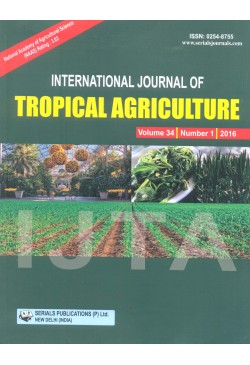
International Journal of Tropical Agriculture
Frequency :Quarterly
ISSN :0254-8755
Peer Reviewed Journal
Frequency :Quarterly
ISSN :0254-8755
Peer Reviewed Journal
Management of Leaf Spot Disease of Aloe vera
Aloe barbadensis ( L.) is a perennial, drought-resisting, xerophytic plant belonging to the family ‘Liliaceae’. The name, Aloe, is derived from the Arabic “alloeh” or Hebrew “halal” meaning bitter shiny substance. The leaves are 40-60 cm long, erect, broad, thick and fleshy succulent, glaucous-green in colour, narrow-lanceolate in shape with long acuminate tip with small thorns on both edges. The central bulk of the leaf contains colourless mucilaginous pulp (Aloe vera gel), made up of large, thin walled mesophyll cells. The plant contains 95 – 96% water and over 75 other constituents which include vitamins, minerals, enzymes, sugars, phenolic compounds, saponins and amino acids (Boudreau and Beland, 2006). Aloe vera is also used as a food substance, possibly for its gelling properties . It has been reported that leaf spot of Aloe vera was incited by Alternaria alternata that can cause economic losses in the cultivation of the Aloe vera. (Rukhsana et al., 2010) A total of 15 fungi, including Alternaria alternata ,Fusarium roseum, Fusarium oxysporum, Alternaria dianthi, Aspergillus niger, Aspergillus fumigatus, Drechslera australiensis, Curvularia senegalensis, Colletotrichum dematium, Nigrospora oryza, and Trichoderma viride were isolated from the leaf samples of Aloe vera collected from different areas (Singh et al., 2014).Surveys have shown that the common disease on the Aloe vera plants was leaf spots which causes harmful effects on the medical value of the plant parts, and other fungi Fusarium solani, Aspergillus niger, Penicillium spp. were recorded (Chavan and Korekar, 2011)
Determination of Compatibility of Fungitoxicants & de-oiled cakes with Bioagent in wheat rhizosphere
Importance of wheat (Triticum aestivum L.) as staple food is well known as nearly 35% of the world population depends on wheat and demand for wheat is expected to grow faster than any other major crop. It provides about 20 percent of the total food calories for the human being. Wheat is grown primarily for the grain which is ground and utilized in the form of flour called atta or whole-meal for the manufacturing various kinds of breads, cakes, cookies, crackers, breakfast, cereals etc. The wheat producing states in India are Bihar, Gujarat, Haryana, Madhya Pradesh, Maharashtra, Punjab, Rajasthan, Uttar Pradesh, Uttarakhand and West Bengal. In Uttar Pradesh area under wheat is 9.65 million hectares with total production of 26.87 million tones with productivity of 2786 kg ha-1. Productivity of wheat in Uttar Pradesh is at par with the country but far behind than potential wheat cultivating states i.e Haryana and Punjab. Estimated productivity of Punjab is 4596 kg/ha during 2015-16 which is 1810 kg ha -1 higher than that of Uttar Pradesh for the same period (Anonymous 2016). In recent past, several bioagents including Trichoderma harzianum and Pseudomonas fluorescens have been found to minimize the effect of moisture stress in several crops; hence it is assumed that these bioagents may be helpful in mitigating certain physiological stress. However the agrochemicals often being used in wheat cultivation also must be tested for their compatibility with these bioagents
Effect of Low Temperature on Physiological and Biochemical Parameters in Selected Rice Genotypes
A field and laboratory study was conducted by selecting 30 rice genotypes along with two cold tolerant check varieties (CTH-1 and CTH-3) to know the “Effect of Low Temperature on Physiological and Biochemical Parameters in Rice Genotypes”. The laboratory experiment was carried out at Department of Crop physiology, UAS Bangalore and the field experiment was carried out at College of Agriculture V.C. Farm Mandya, during late kharif- 2019. Under laboratory condition seed germination test was done with four temperature regimes viz:, 28°C (control), 10°C, 12°C and 15°C. The results revealed that among the selected rice genotypes, Thanu, Daksha, KRH-4, NLR-3042, BPT x BR -6, GVT-501, GVT-4, Jyoti, Raksha, KMP-149 and IR-64 were found better in germination percentage, seedling length, changes in coleoptile length etc. However, the genotypes Thanu, Daksha, KRH-4, BPT x BR-6, GVT-501, Jyoti, Raksha, KMP-128 and KMP-200 were showed cold tolerance in field condition w.r.t three dates sowing. These genotypes can be used further for crop improvement in breeding programme.
Keywords: cold tolerance, rice genotypes, low temperature, biochemical parameters in rice
Comparative Morphology of Betelvine (Piper betle L.) cultivars in West Bengal
The experiment was conducted during 2012-13 and 2013-14 in a baroj of experimental farm of AICRP on Betelvine, Kalyani, Bidhan Chandra Krishi Vishwavidyalaya, Mohanpur, West Bengal, India. Total eight betelvine cultivars were collected from different locations of India and conserved. Remarkable variations in vegetative growth, morphological features and yield attributes of betelvine were recorded. The betelvine cultivars varied in intermodal length (6.35 cm – 8.49 cm), the leaf length (12.77 cm – 15.56 cm), leaf breadth (8.00 cm – 11.30 cm), petiole length (4.75 cm – 6.80 cm) among the cultivars throughout the year. Internodal length was highest in the month of January (8.00 cm) while July showed minimum (6.87 cm). September possessed maximum (14.79 cm) and May showed minimum (13.69 cm) leaf length. Leaf breadth was maximum in the month of January (9.97 cm) followed by May and September. Lowest petiole length was observed in the month of July (5.71 cm) followed by November and May. Interaction between the cultivars and time was found significant in all the morphological characteristics. Variations were also existed among the cultivars in vine colour, leaf colour, leaf shape, leaf tip and sex of cultivars.
Keywords: Betelvine, Morphological features, Variety, Kapoori, Sanchi.
Study on Drying Kinetics for Shredded Ginger through Microwave Heating Followed by Hot Air Drying
This study focused on the drying kinetics for shredded ginger through microwave heating followed by hot air drying. Following objectives were pursued: To study the effect of microwave power level & hot air drying temperature on moisture depletion of shredded ginger sample, To determine the drying rate & drying constant at different MW power levels and HAT. The research contributes to the understanding of the drying behavior of shredded ginger and provides valuable insights into the selection of drying methods to preserve its quality and nutritional value. Notably, the results indicated that the effect of microwave power level can be seen as, the initial moisture content of shredded ginger was 473.4 % (db) which reduces to moisture content level of (435.49% db) for 300W, ( 409.38 % db ) for 450W and (384.80% db ) for 600W after pre-heating in microwave. In hot air drying, to attain moisture content value of approximately 50%(db) it takes 9 hours of drying at 60°C whereas approximately same moisture level can be achieved in 6 & 4.5 hours when drying takes place at 70°C & 80°C respectively. This showed that as the air temperature rises, the drying time of shredded ginger reduces. The drying rate increases with increase in power level and hot air temperature. Maximum drying rate for control i.e. 80°C HAT was found to be 3.63 gm of water/gm of dry matter-min and for 600W MWH & 80°C HAT was 4.757 gm of water/gm of dry matter-min. The value of drying constant increases with increasing microwave pre-heating power level and hot air temperature & its value varies from 0.28 to 0.94 min-1.
Assessing Instability in Onion Cultivation, Production, and Yield in India: A Modified Cuddy-Della Approach
The present study analyzes the instability in onion cultivation, production, and yield across major states of India from 1985 to 2022 using secondary data sourced from www.indiastat.com and Agricultural Statistics at a Glance. The study employs the Cuddy and Della (1978) instability index, with modifications to account for non-linearity in time series trends. The analysis is conducted over three distinct periods: Period I (1985–2003, traditional technology), Period II (2004–2022, modern technology), and Period III (1985–2022, entire study period). The findings reveal significant variability in onion cultivation, with Maharashtra exhibiting the highest instability in area under onion during the modern technology phase, while Madhya Pradesh and Karnataka displayed relatively lower instability. At the national level, instability in onion area increased from 7.628 in Period I to 11.160 in Period II, reflecting regional fluctuations. Production instability followed diverse patterns, with Maharashtra experiencing a substantial increase in instability, whereas Madhya Pradesh saw improved output stability. Yield instability exhibited mixed trends, with Gujarat showing a decrease while states like Madhya Pradesh and Karnataka recorded an increase. The study highlights that modern technology has influenced instability differently across states, emphasizing the need for region-specific policy interventions to ensure sustainable onion cultivation.
Keywords: Area, Coefficient of Variation, Cuddy Della Valla Index, Onion, Production, Instability, Yield
Resource Use Efficiency of Cauliflower Production in Sultanpur District of Uttar Pradesh
The present study investigates the resource-use efficiency and returns to scale in cauliflower production across different farm sizes in Sultanpur district, Uttar Pradesh. A multistage stratified purposive cum random sampling method was employed to select 120 cauliflower growers categorized into marginal, small, and medium farm sizes. Primary data were collected through personal interviews using a pre-tested schedule, while secondary data were obtained from district-level government sources and relevant literature. To evaluate the economic efficiency of key inputs, the Cobb-Douglas production function was applied using least square estimation techniques. The analysis revealed that the coefficients of multiple determination (R²) for marginal, small, and medium farms were 0.863, 0.881, and 0.900 respectively, indicating a high explanatory power of the model. The sum of production elasticities across all input variables suggested decreasing returns to scale in all farm categories. The input variable such as seed, machinery charges, plant protection, and irrigation were found to be significant contributors to yield, with variations across farm sizes. Marginal value productivity (MVP) estimates for all inputs were positive, underscoring the scope for enhancing input use efficiency. These findings provide critical insights into optimizing resource allocation and enhancing productivity in cauliflower cultivation, particularly in resource-constrained regions.
Keywords: cauliflower, cobb-douglass, decreasing returns to scale, resource use efficiency.
Screening of Some New Substrate for Mass Multiplication of Trichoderma harzianum and Pseudomonas fluorescens and Determination of Suitable Moisture Level
Various low-cost agricultural waste products were screened for mass multiplication of T. harzianum and Pseudomonas fluorescens under normal storage condition and most effective formulated product of T. harzianum and Pseudomonas fluorescens was evaluated in vitro . Among different substrate including some of farm wastes and residues viz. wheat straw, wheat straw + rice husk, rice straw, sugarcane bagasse, sugarcane pressmud, bajra grains + wheat straw, sorghum grains + rice husk, chick pea flour + wheat straw, rotten cow dung + unrotten cow dung. The sorghum grains + rice husk was best growth substrate for T. harzianum and chickpea flour + wheat straw was best substrate for P. flourescens. 70 per cent moisture was appropriate for the growth and mass multiplication of both the antagonist.
Keywords: Biocontrol agents, Moisture, Substrate.
Assessment of Genetic Variability and Correlation Studies among Elite Sugarcane Genotypes Under Rainfed Conditions (Saccharum Officinarum L)
The present study evaluated the extent of genetic variability, correlation of traits among fifteen promising popular released and prerelease clones along with a standard CoA92081 were tested under rainfed situation at RARS, Anakapalle under rainfed conditions from 2020-21 to 2021-22. Additive gene action for NMC, stalk length, ccs yield and cane yield suggested for improvement through simple selection. Low to moderate GCV, PCV, heritability and GAM for traits like germination percent, brix percent, sucrose percent, purity percent, pol percent cane, fibre percent implies the narrow range of variability and importance of non-additive gene action in inheritance of the characters. Low to moderate estimates of GCV, PCV coupled with moderate heritability and GAM for traits of CCS %, Juice extraction percent, number of green leaves at 120 DAP, LAI at 120 DAP, SCMR at 120 DAP, stalk girth and single cane weight indicative of both additive and non-additive gene action in inheritance of characters. The correlation between Cane yield, NMC, Stalk length, stalk girth, single cane weight, brix, germination percent and CCS yield had positive significant correlation at both genotypic and phenotypic level. The elite clones identified viz., CoA 11321,CoA 16321,CoA 17324,CoC 17337 and 2014A 224 can serve as valuable genetic resources for developing climate resilient sugarcane genotypes through targeted breeding efforts.
Keywords: Genetic Variability, GCV, PCV, Correlation, Rainfed conditions, Sugarcane
Field Efficacy of Triflumezopyrim 10.6 SC against the Mixed Populations of Rice Planthoppers in Godavari Delta
A field experiment was conducted at A.P. Rice Research Institute and Regional Agricultural Research Station, Maruteru, West Godavari district during Kharif 2013 and 2014 to test the bio-efficacy of triflumezopyrim 10.6 SC at different dosages against planthoppers viz., Brown planthoppers and White backed planthoppers in rice. The results revealed that all the dosages of triflumezopyrim 10.6 SC tested viz., 5, 15, 25 and 35 g a.i./ha, were significantly superior in reducing the buildup of planthoppers than treated checks i.e. fipronil 5 SC @ 50 g a.i./ha and buprofezin 25 SC @ 200 g a.i./ha and untreated control in both the seasons up to 28 days after the spray. Among all the dosages, triflumezopyrim 10.6 SC @ 35 g a.i./ha (4625 and 5478 kg/ha), triflumezopyrim 10.6 SC @ 25 g a.i./ha (4594 and 4885 kg/ha) recorded significantly superior grain yields during Kharif 2013 and 2014 respectively.
Keywords: Triflumezopyrim, BPH and WBPH, Field efficacy.
Disinfestation of Imported Germplasm against Insect Pests using Fumigant
Ethylene dichloride-carbon tetrachloride (EDCT) mixture (3:1) was used as a fumigant at 320 mg/litre for 48 h or at 640 mg/litre for 24 h under normal air pressure to disinfest germplasm/ trial material meant for import and export against insect pests. During 2023 and 2024 a total 1,096 imported samples of different crops, i.e. Oryza sativa L. (608), Triticum aestivum L. (279), Triticum durum Desf. (5), Lens culinaris Medik. (91), Vicia faba L. (76), Pisum sativum L. (19), Hordeum vulgare L. (13) and Lathyrus sativus L. (5), were found infested by immature stages of bruchid, Bruchus dentipes (Baudi), B. lentis (Frolich), Acanthoscelides obtectus (Say), Rhyzopertha dominica (Fabricius), Tribolium castaneum (Herbst), Trogoderma granarium (Everts), Sitophilus oryzae (L.), Sitotroga cerealella (Olivier) and Cryptolestes ferrugineus (Stephens). All the 1,096 infested germplasm/trial material samples were successfully disinfested against insect pests by EDCT fumigation at the given dosage. However, a total 13,012 imported germplasm samples of various crops were also given prophylactic treatment with EDCT fumigation during 2023 and 2024.
Keywords: Crops, Ethylene dichloride-carbon tetrachloride (EDCT), Fumigation, Germplasm, Quarantine
Interception of Weed Seeds in Rice Seeds Imported from Different Countries
The Regional Plant Quarantine Stations in the country and Division of Plant Quarantine at ICAR-National Bureau of Plant Genetic Resources (NBPGR), New Delhi conducts seed quarantine tests of incoming and outgoing rice seeds. Fifteen percent of the incoming rice seed shipments were found contaminated with weed seeds. Twenty-five weed species were intercepted and identified as rice seed contaminants out of which Echinochloa crus-pavonis is a quarantine weed for India and listed in Schedule VIII of Plant Quarantine (Regulation of Import into India) Order (2003). Echinochloa spp. were the most frequent, with as many as 436 seeds per seed-lot. Seeds of Echinochloa spp. were found to harbour saprophytic fungi like Curvularia lunata, Fusarium semitectum, Phoma sp., Cladosporium sp. and Alternaria longissima that can cause grain discoloration in rice grains were detected at high levels. Plant pathogenic seed borne fungi like Bipolaris oryzae which causes leaf spot of rice and Fusarium moniliforme that causes bakanae disease of rice were detected at low levels. More care in processing imported rice seeds for research and propagation purpose is needed to prevent weed seed contamination and spread.
Keywords: Weed seeds, seed shipments, quarantine weed, germplasm exchange.
Occurrence and Pathogenicity of Fungal Pathogens in Guinea Corn, Millet and Wheat Seeds and their Control with Extracts of Garlic (Allium sativum) Cloves and Pawpaw (Carica papaya) Seeds
This study investigated the occurrence, pathogenicity, and in vitro control of fungal pathogens associated with wheat, sorghum, and millet seeds using garlic (Allium sativum) cloves and pawpaw (Carica papaya) seed extracts. Extracts were tested at concentrations of 0g/200 mL, 50g/200 mL, 100g/200 mL, and 150g/200 mL, with experiments conducted in a completely randomized design, replicated three times, and incubated at 28 ± 2°C for five days. The fungal pathogens identified included Aspergillus niger, A. flavus, and Lasiodiplodia theobromae, with A. niger showing the highest frequency in sorghum (53.33%), millet (58.33%), and wheat (68.75%), while L. theobromae had the lowest frequency in these cereals (sorghum: 26.67%, millet: 16.67%, wheat: 12.50%). Pathogenicity tests revealed that A. niger and L. theobromae were highly pathogenic in wheat and very highly pathogenic in sorghum and millet. Garlic and pawpaw extracts effectively inhibited the radial growth of these fungi, with the highest concentration (150g/200 mL) exhibiting the greatest antifungal activity. Significant differences (P ? 0.05) were observed for growth inhibition across incubation days, extract types, and fungal pathogens. The findings suggest that garlic and pawpaw extracts at optimized concentrations can serve as eco-friendly alternatives for managing fungal pathogens in cereals, particularly wheat, sorghum, and millet. Formulating these extracts into sustainable seed treatment technologies could help mitigate post-harvest losses, enhance food security, and align with environmentally sustainable agricultural practices
Keywords: Food security; Garlic Pathogenicity test; Pawpaw; Post-harvest
An Application of a Univariate Model to Forecast Millet Production in India
Millets are small-seeded crops classed as Major (Sorghum, Pearl millet, and Finger millet), Minor (Foxtail, Kodo, Banyard, Little, and Proso millets), and Pseudo (Amaranth and Buckwheat). Millets are referred to be nutri-cereals since they are highly nutritious and can greatly contribute to food and nutritional security. India is the world’s largest millet grower, accounting for 43 percent of global production. India, Niger, China, Nigeria, and Mali produce 73 percent of the millet produced. India ranks 31st in the world in terms of yield per hectare. Labeling these crops as Nutri-cereals has been promoted in order to enhance demand and allow farmers to seek higher prices. According to the government, millets have a high potential for considerably contributing to the country’s food and nutritional security, and hence they are not only a nutrient powerhouse, but also climate-adaptable crops with unique nutritional features. The purpose of this study is to develop an ARIMA model for forecasting millets production in India. The annual data were obtained from 1966-67 to 2023-24 from the Directorate of Economics and Statistics, Ministry of Agriculture and Farmers’ Welfare, Government of India. The data was fitted using the ARIMA model in order to project future millet production in India. The univariate Box-Jenkins (1970) ARIMA approach has been used for forecasting. The model parameters were estimated using the R programming language. The fitted model’s performance was evaluated using multiple measures of goodness of fit. Projections for the years 2024-25 to 2029-30 are calculated using the chosen model. The numerical and graphical results of millet production are displayed graphically. These estimates are especially useful for altering marketing and policy campaigns to account for future changes.
Keywords: ACF – Autocorrelation Function, ARIMA – Autoregressive Integrated Moving Average, MAPE, Millets, PACF – Partial Autocorrelation Function, Residual Analysis.
Scientific Journey for Bio fortified salt tolerant sweet potato, taro and other tropical tubers – The Food in need is the Food indeed
I wished the papers of Kalbach and Satell in 2012, 2013 respectively would have been published much earlier prior to my professional journey- “Before you Innovate, Ask the Right Questions”. It is applicable to all streams of subjects. I got thrilled when I had read it. At the same time I felt myself fortunate that what they have suggested, nature had taught me in October 1999. In fact, our higher qualifications, knowledge, innovations, have no value when “Nature” becomes furious. I was quite happy after joining ICAR-CTCRI through Agricultural Research Service (ARS) examination in the year 05.02.1986 in Thiruvananthapuram, Kerala. With the back ground of plant biotechnology, I have started working on Micro propagation, meristem tip culture to generate healthy propaguels of different tuber crops. In December 1994, I got transfer to Regional Center of ICAR-CTCRI located in Bhubaneswar, Odisha, India. I was quite happy as my native place is just overnight journey but got disappointed as there were no proper facilities to work. I could not imagine to work again on biotechnology. I got upset for sometime and then went for my Ph.D. Studies in CSIR- IMMT, Bhubaneswar with CSIR – SRF fellowship. I had persuaded my doctoral study under Late Dr. B.K. Debata and S.K. Naskar. After three years, I joined back Regional Centre but situation was almost the same. With guidance of my senior Dr. S.K. Naskar, I had accepted the field research and started working with him. Then the turning point had come in October 1999 through “Super Cyclone”. It taught all of us a lot, especially our higher qualifications have no value when there is vagaries of nature. During such situation only commonsense works. I was suggested to take care of affected farm families of Kendrapada under contingent action plan of ICAR. I distributed them different tuber crops of different varieties. It was observed that very few could sustain under the ingress of saline water. That mooted me to think ‘why so?’ I started working rigorously with two of my Ph.D. students viz. M.R. Sahoo and M. Dasgupta. We worked hard to establish biotech laboratory with externally funded projects. We could come out with good results on salinity tolerant sweet potato and taro. Subsequently we strengthened the irrigation source and drip irrigation facility in our farm. Our first salt tolerant purple flesh sweet potato variety “Bhu Krishna (anthocyanin 90mg/100g, starch 22-23%)” and delicious salt tolerant orange flesh “Bhu Sona (beta carotene 14mg/100g, starch-20-22%)” have attracted not only the farmers but the Agro experts of the state, Nation and across. An overview of my scientific professional journey especially on sweet potato and taro is projected. The work plan I proposed as Director and had executed in strengthening R&D of Regional Centre, Head quarter as well as enhancing visibility of tropical tubers in and across Nation are also highlighted.
Keywords: Scientific Journey, Bio fortified, Salt tolerant, Sweet potato, Taro, Food in need
A Thermodynamic Basis of Food Web & Edible Energy
This study presents edible energy as a continuum of structured energy transformations, beginning at sub-biological and environmental levels before entering biological systems. Through methods involving thermodynamics, nanoscience, molecular biology, and atmospheric modeling, it is shown that food energy arises from solar radiation, mineral substrates, entropy gradients, and microbial interactions, well before photosynthesis initiates biomass formation. Modern scientific techniques such as GC-MS, XRD, and calorimetry support this multi-phase energy flow. Ancient Indian scriptures, notably the Taittir?ya ?ra?yaka, aligns with modern mass-energy equivalence and biochemical energy logic. The findings reveal a convergence between empirical science and early Indian scientific formulations, demonstrating that food is not only biological substance but structured, mass-bound energy. These results provide a scientific framework linking ancient and modern understandings of energy in ecosystems, with applications in food science, sustainability, and environmental modeling.
Keywords: Nature, Food Web, Thermodynamics, Edible Energy, Ancient Wisdom
Documentation of Indigenous Uses and Traditional Practices of Ethnomedicinal Plants Used by the Inhabitants for Respiratory Disorders in Baagi and
Munjhag Catchments of Mandi District, Himachal Pradesh, North-Western Himalaya, India&
The present investigation was conducted in Baagi and Munjhag Catchments of Mandi district in Himachal Pradesh between 2018 and 2021. The surveys and interviews of the inhabitants and local Vaidyas resulted a total of 44 plant species belonging to 29 families, representing trees (6 spp.), shrubs (9 spp.) and herbs (29 spp.) utilized for addressing a range of respiratory ailments, including asthma, bronchitis, colds, coughs, pneumonia, tuberculosis, whooping cough, lung disorders, sinusitis, and issues related to phlegm. Diverse preparations were made using the leaves (26%), roots (15%), whole plant (15%), fruits (15%), seeds (12%), flowers (6%), barks (4%), rhizomes (2%), and each of the aerial part, shoot, latex, wood, and tubers accounted for 1% each. The leaves and roots emerged as the preferred components. The Use value (UV) and Informant Consensus Factor (ICF) of wild medicinal plants offer important insights into the effectiveness of these plants for different respiratory conditions. The excessive collection of medicinal plants from natural habitats poses significant concerns regarding their future viability. Consequently, it is crucial to urgently document indigenous knowledge and to promote sustainable utilization and conservation practices among local inhabitants to preserve valuable traditional knowledge.
Keywords: Baagi and Munjhag Catchments, Ethnomedicinal Plants; Respiratory Disorders; Use Value; Informant Consensus Factor (ICF); Sustainable utilization
Evaluation of Promising Elite Sugarcane Genotypes in drought Situation of Tropical Region of India
Sugarcane clones tolerant to drought is the need of the hour as sugarcane yields were drastically reduced under drought situation. The present study was carried out at Regional Agricultural Research Station, Anakapalle (2020-21 to 2021-22) and at M/s Etikoppaka sugar factory site (2019-20 to 2020-21) where in the situation prevails. Field experiments were conducted at RARS, Anakapalle as well as M/s Etikoppaka sugar factory site in RCBD with three replications in a gross plot size of 8 mt x 0.8m x 8R = 51.20 m2 and net plot size of 8m x 0.8m x 6R = 38.40 m2. Recommended practices were followed for drought situation. Among 18 pre release clones tested along with a standard CoA 92081 (87A 298), three clones were found promising for cane yield, CCS yield, sucrose percent, yield components and physiological stress tolerance were 2016A 592, 2016A 672 and 2016A 580 whereas at M/s Etikoppaka sugar factory site, three varieties viz., 2000A 225, 2000A 213 and 2004A 107 were proved to be drought tolerant as they were significantly superior for cane yield, CCS yield, sucrose percent besides superior yield components like number of millable canes, cane length, cane diameter and single cane weight. In addition to the data, they were found superior for physiological parameters like SCMS values, leaf area index, water use efficiency, root volume and leaf proline content etc., these clones can be given to farmers of their sugar factory operational areas. Based on their performance and acceptance by sugarcane farmers, can be released for general cultivation in tropical zone of India. The promising elite genotypes evolved from the study viz., 2016A 592, 2016A 672 and 2016A 580 can further be tested in hybridization programs with targeted breeding approach besides pre breeding objectives. Identification of stress tolerant genotypes represent valuable genetic resources for future varietal improvement in sugarcane breeding programs.
Keywords: Sugarcane – Elite genotypes – drought situation – Tropical region of India.
Novel Methods for Investigating the Pathogenicity of Ralstonia solanacearum in Three- to Four-Leaf Stage Brinjal Seedlings
Bacterial wilt disease, caused by Ralstonia solanacearum (Smith), is a serious plant disease that is responsible for heavy losses to a large number of economic host plants it infects. Bacterial wilt of brinjal is a severe problem in Jharkhand state due to acidic soil. This study aimed to enhance our understanding of artificial inoculation methods in brinjal plants, focusing on their role in proving pathogenicity and virulence. Among all other methods, needle inoculation methods were found to be the most efficient. The needle inoculation method recorded significantly higher bacterial wilt incidence, recording 51.7%, 81.7%, and 81.7% at 7, 15, and 30 days after inoculation, respectively followed by soil inoculation method with wilt incidence of 63.3%, 73.3%, and 78.3 at 7, 15, and 30 days after inoculation (DAI). Wilt incidence recorded in the leaf clipping method of inoculation was comparatively less, i.e., 31.7%, 38.3%, and 48.3% at 7, 17, and 30 DAI. However, no wilt symptoms were recorded from the seed inoculation method at 7, 15, and 30 DAI. The needle inoculation method of artificial inoculation is seen to have a higher degree of wilting from 7 DAI to 30 DAI as compared to other artificial inoculation methods.
Keywords: artificial inoculation, bacterial wilt, brinjal, pathogenicity, Ralstonia solanacearum.