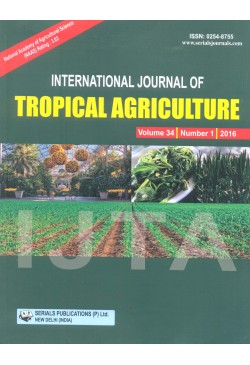
International Journal of Tropical Agriculture
Frequency :Quarterly
ISSN :0254-8755
Peer Reviewed Journal
Frequency :Quarterly
ISSN :0254-8755
Peer Reviewed Journal
Exotic Bruchids in Legume Grains Imported from Different Countries
Quarantine examination of 8,38,686 imported seed samples of various legume crops during 2015-2024 revealed presence of exotic bruchids commonly called pulse beetles in 3137 samples which were detected by X-ray radiography. Thirteen exotic bruchid species viz., Acanthoscelides desmanthi in Desmanths spp. from Colombia, A. obtectus in Phaseolus vulgaris from Argentina, Colombia Mexico, Peru; Bruchidius atrolineatus in Vigna unguiculata from Nigeria; Bruchus affinis in Vicia faba from Afghanistan; B. dentipes in Vicia spp. from Afghanistan, and Syria; B. ervi in Lens spp. from Afghanistan, Chile, Cyprus, Ethiopia, Germany, Greece, Syria, Iran, Iraq, Italy, Jordan, Lebanon, Mexico, Morocco, Russia, Syria and Turkey; B. nubilis in V. faba from Ukraine; B. rufimanus in V. faba from Afghanistan, Canada, Spain and Syria; B. signaticornis in L. culinaris from Syria; B. tristis in Lathyrus odoratus from Syria; B. tristiculus in V. narborensis from Portugal; Callosobruchus rhodesianus in Vigna unguiculata from Nigeria and C. subinnotatus in V. subterranea from Ghana were intercepted. Many of the pulse beetles were intercepted repeatedly from the same/ different source(s) year after year. All the infested samples were salvaged using suitable disinfestation treatments. None of the intercepted beetles are yet reported from India, and are therefore, of high quarantine significance
Keywords: Bruchids, Exotic, Germplasm, Interception, Legumes, Seed beetles.
Jackfruit: A Nutritional Powerhouse, Cultural Icon, and Rising Global Treasure
Jackfruit (Artocarpus heterophyllus Lam.) is a tropical fruit renowned for its versatility in culinary and therapeutic applications. Widespread in tropical regions, jackfruit is consumed fresh, as a snack, or in processed forms such as flour and value-added products. Beyond its culinary uses, jackfruit has a long history in traditional medicine, with its various parts, seeds, and bark—providing health benefits. Rich in carbohydrates, proteins, vitamins, and essential minerals, jackfruit is particularly noted for its high content of bioactive compounds, including phenolic compounds and flavonoids, which contribute to its notable antioxidant, anti-inflammatory, antimicrobial, anticancer, and antifungal properties. The fruit’s broad therapeutic potential is attributed to these bioactive compounds, which play a role in reducing oxidative stress and may aid in the prevention of chronic diseases. Moreover, jackfruit seeds, often overlooked, are also nutrient-dense and contribute to its health-promoting profile. The diverse applications and nutritional composition of jackfruit make it a valuable addition to health-focused diets and an interesting subject for further research in food science and nutrition.
Keywords: Jackfruit, bioactive compounds, antioxidant, therapeutic properties
Effect of Integrated Nutrient Management on Growth and Yield of Grain Amaranth (Amaranthus hypochondriacus L.)
A field experiment was conducted during rabi season of 2022-23 to study the effect of integrated nutrient management on growth and yield of grain amaranth. Growth and yield attributes such as plant height, dry matter accumulation per plant, length of inflorescence, test weight, grain and stalk yield were recorded significantly higher by the application of 100% RDF + vermicompost @ 1 t/ha + seed inoculation with Azotobacter and PSB followed by 75% RDF + vermicompost @ 1.5 t/ha + seed inoculation with Azotobacter and PSB and 100% RDF + FYM @ 2.5 t/ha + seed inoculation with Azotobacter and PSB. It also recorded significantly higher returns.
Keywords: Azotobacter, economics, farm yard manure, grain amaranth, grain yield, PSB, Vermicompost
Studies on performance of transplanted Finger Millet in Surahonne based Agroforestry System Under Varied Nutrient Level Practices
Field experiment was conducted during kharif-2018 at Bio fuel park Madenur, University of Agricultural Sciences, Bangalore. The experiment comprised of seven treatments with three replications laid out in randomized block design. The experimental soil was red sandy loam with neutral in reaction (pH 6.8) and the electrical conductivity was normal (0.26 d Sm-1 at 25 °C). The available nitrogen present in the soil was medium (337 kg ha-1) , the available phosphorus was high 34 kg ha-1 and medium potassium 290 kg ha-1. The results revealed that significantly higher finger millet grain and straw yield (2792 and 5164 kg ha-1, respectively) was recorded with (T7) application of 75% N equivalent through neem cake+ 25% through RDF + 2% 19:19:19 water soluble foliar spray. The higher yield of finger millet was attributed due to higher number of tillers (5.30 plant-1), total dry matter (35.52 g plant-1), ear length (6.98 cm) and 1000 grain weight (3.68 g). It was on par with (T2) application of 75% N equivalent through pongamia cake + 25% through RDF + 2% water soluble 19:19:19 foliar spray (2606 and 5052 kg ha-1, respectively) and recommended package of practice(T1) (100:50:50) N, P2O5, K2O kg ha-1 + FYM @ 10 t ha-1 (2504 and 4973 kg ha-1, respectively). Lower grain and straw yield (1888 and 3549 kg ha-1, respectively) of finger millet was recorded with (T4) application of 25% N Equivalent through pongamia cake+ 75% through RDF + 2% water soluble 19:19:19.
Keywords: Agro forestry, Finger millet, Macronutrients
Effect of Magnesium on Cannabis Biomass Yield and Cannabinoids Content: Evaluating Different Application Rates and Methods
Magnesium deficiency (MGD) is a severe problem in plants. Magnesium (Mg) is one of the important nutrients involved in many enzymatic activities and rarely studied in cannabis. In this study, the effect of application of different concentrations (0.75 ml L-1 of ‘Advanced Nutrients Bud Factor X’ equivalent to 3.75 mg L-1 of Mg, 2ml L-1 of ‘Advanced Nutrients Bud Factor X’ equivalent to 10 mg L-1 of Mg, and 4ml L-1 of ‘Advanced Nutrients Bud Factor X’ equivalent to 20 mg L-1of Mg), and methods of application (Soil Drench vs. Foliage Application) of magnesium was studied on useable biomass yield and cannabinoids content on two chemovars (high CBD and high CBG) of Cannabis sativa L. Plants grown through feminized seeds were divided into two groups, control (no treatment) and treated with different concentrations of Mg (10 mg L-1 soil drench, 20 mg L-1 soil drench and 3.75 mg L-1 foliage spray). Plants of both groups were grown side by side in an identical environmental condition in a polytunnel and, were watered and fertilized normally. The application of different concentrations of magnesium began in the first week of flowering and continued until maturity. Both groups of plants were harvested at maturity, processed for usable dry biomass, and compared for biomass production per plant and cannabinoid content. Our results show that among all treatments (Soil Drench and Foliage Application), the maximum increase in cannabis biomass per plant in CBD-rich chemovars was achieved with the application of 10 mg L?1 Mg, whereas the highest increase in biomass per plant in CBG-rich chemovars was achieved with the application of 20 mg L?1 Mg. On the other hand, the maximum increase in CBD content per plant (in the CBD-rich chemovar) and CBG content per plant (in the CBG-rich chemovar) was observed with the application of 10 mg L?1 Mg to the soil, compared to the ‘control’ plants.
Keywords: Biomass yield, Cannabis sativa L., Cannabidiol, GC-FID, ?9- Tetrahydrocannabinol, Magnesium
Isolation and Identification of Soil-born fungi from Citrus Orchards of ICAR-IARI, New Delhi, India
Most of the soil-born fungi are pathogens and cause diseases to plants. Susceptibility of plants to these soil borne diseases is the most concerning part which present a common threat to agricultural production and productivity. In the present study, the soil samples were collected from different citrus orchards of ICAR-IARI, New Delhi. The isolation of fungal isolates was done on Sabouraud dextrose agar (SDA) media by following serial dilution and spread plate technique at temperature and incubation period of 300C and 24 hours respectively. Based on the morphological and gram staining, a total of 9 different species of soil-borne fungi were isolated, among which Rhizopus and Mucor were dominant. Further it was found that 3 different species of Aspergillus viz. A. versicolor, A. glaucus and A. flavus were also identified. All three species of Aspergillus are considered as pathogens of important crops and A. flavus is able to produce potent mycotoxins. It was concluded that the soils of citrus have a good diversity of fungal species and some of the isolates were pathogenic as per the available scientific literature. Hence the research provides the early alarm for the presence of pathogenic fungi that can be detrimental to crops and thus the loss can be prevented by taking early preventive measures.
Keywords: Soil-born fungi, citrus, isolation, serial dilution
Technology Adoption and Impact in Dairy Farming
Dairy farming necessitates daily decision-making and a holistic approach to ensure profitability, consumer well-being, environmental responsibility, and product quality. This study examined the adoption of precision dairy technologies using a mixed-method approach focusing on milking efficiency. It covers motivations for investment, anticipated benefits, and maintenance practices. Conducted across 20 dairy farms in Anand and Vadodara districts the survey involved 80 respondents. Data analysis, performed using Excel, categorized responses into agree, neutral, and disagree to address response skewness. Findings revealed that labour savings and simplifying milking processes were key motivations for adopting precision technologies. While most farm owners were satisfied with technical support and training, challenges such as system data integration persisted. Many users relied on the technology for data entry, alert monitoring, and training but noted underutilization of advanced system functionalities, underscoring a need for improved user guidance. In developing countries like India, precision dairy farming is still emerging but offers significant potential for improving individual animal and herd management by enhancing animal health, welfare, and environmental sustainability, precision farming supports long-term sustainability goals in livestock management.
Keywords: Precision dairy farming, Productivity, adoption, sustainability
Studies on Soil Nutrient Status at Different crop growth stages and yield of chia (salvia hispanica l.) at different sources and levels of organics
Field experiments was conducted during kharif -2019 at College of Agriculture, Hassan, University of Agricultural Sciences, Bengaluru to study soil nutrient status at different crop growth stages and yield of Chia (Salvia hispanica L.) at different sources and levels of organics. At 30,60 DAT and at harvest T9: application of pressmud @15 t/ha recorded significantly higher available nitrogen (500 kg ha-1, 460 kg ha-1and 361 kg ha-1, respectively), available phosphorus (108 kg ha-1, 97 kg ha-1and 86 kg ha-1, respectively) and available potash (436 kg ha-1, 403 kg ha-1and 335 kg ha-1, respectively) followed by T6: application of vermicompost @ 15 t/ha. Significantly lowest available nitrogen phosphorus and potash was recorded in T1: application of FYM @ 5 t/ha. This soil nutrient status at different crop stages reflected in significantly higher Grain yield and Straw yield (1277 kg ha-1 and 3365 kg ha-1, respectively) followed by T6: application of vermicompost @ 15 t/ha (1137 kg/ha kg/ha, respectively). Significantly lower grain and straw yield ha-1was recorded in T1: application of FYM @ 5 t/ha (540 kg/ha and 1403 ka/ha).
Keywords: Organic sources, Available nitrogen, phosphorus and potassium
Scales and Mites in Vegetative Plant Material Imported from Different Countries
Quarantine examination of 3,028 exotic vegetative samples of various crops during 2023 and 2024 revealed infestation of insect and mites in 193 samples. These included five species viz., Aceria tulipae in Allium sativum from Kazakhstan and USA, Amphitetranychus viennensis in Pyrus communis from USA, Polyphagotarsonemus latus in Persea americana from Vietnam and Oligonychus peruvianus in P. americana from USA and also four species of scale insects, Aonidiella orientalis in Vitis vinifera from Brazil, Aspidiotus nerii in cuttings of P. communis from USA, Chrysomphalus dictyospermi and Hemiberlesia lataniae in P. americana from USA and Parasaissetia nigra in P. americana from Vietnam. All the infested samples were salvaged using suitable pesticidal dip treatment.
Keywords: Quarantine, germplasm, vegetative, scales, mites, salvage.
Profiling and Quantification of Phytocannabinoids for the Classification of Cannabis sativa L. Varieties
Whether cannabis is one species or more, is a long-standing topic of debate within the research community. However, according to the current scientific consensus, cannabis is considered as a single but highly variable species, Cannabis sativa L. On the other hand, cannabis can also be classified based on its cannabinoid profile, which is more relevant when the goal is to develop cannabis-based phytopharmaceuticals. Once chemically analyzed, screened, and selected, high-yielding mother plants can be mass-propagated through micropropagation or vegetative propagation to ensure batch-to-batch consistency, as well as to maintain quality and efficacy. In this study, plants of different cannabis varieties/chemovars were grown from seeds. Once identified, male plants were removed from the growing area, while only female plants were retained for future research. For the initial screening, biomass samples collected from female plants were analyzed for the cannabinoid content using GC-FID, and the elite mother plants from each variety were further selected. Mother plants were mass-propagated through micropropagation and grown outdoors until they reached maturity. The harvested biomass samples of these plants were then analyzed using GC-FID and NMR spectroscopy. Based on the results, plants were classified into three distinct chemotypes: high THC, intermediate, and high CBD, with clear differentiation. The living germplasm of these plants are further conserved in-vitro for future use.
Keywords: Cannabis sativa L., Cannabidiol, ?9- Tetrahydrocannabinol, GC-FID analysis, NMR-spectroscopy, Principal Component Analysis (PCA)
Instability analysis and forecasting using ARIMA Model in Fruit Production in India
India is a significant agrarian nation, with 77% of India’s population living in rural areas and 90% of that rural population employed directly in agriculture. The country’s main fruit crops include bananas, guavas, papayas, jackfruits, pineapples, mangoes, and others. The primary aim of this study is to forecast the major types of fruit production in India by applying the Box-Jenkins Autoregressive Integrated Moving Average (ARIMA) model using time series models during 1961-2020. The findings indicate that the best ARIMA models for predicting the production of bananas, apples, grapes, mangosteens, guavas, and pineapples are ARIMA(1,1,0), ARIMA(1,1,4), and ARIMA(1,1,5). The comparison between the original and forecasted series, presented in a similar manner, indicates that the fitted model reliably forecasts fruit production in India. In the present investigation aim to analyze the instability of fruit crops in India and to estimate the decomposition analysis of fruit crops specifically in India. To achieve these objectives, secondary data spanning 60 years were analyzed using statistical tools such as the Coefficient of Variation (CV) and Cuddy Della Valle’s Instability Index (CDVI).
Keywords: Fruits Productions, Forecasting, ARIMA Model, trend , instability, India
Genetic Analysis of Proso Millet (Panicum Miliaceum L.) Genotypes for Morpho-Physiological and Biochemical Characters
This study examined 48 proso millet genotypes to evaluate genetic variability, diversity, and trait associations across 15 distinct characteristics. Traits such as yield per plant, peduncle length, leaf width, flag leaf length, and plant height exhibited substantial genetic variability with high heritability and genetic advance, indicating that selection for these attributes would be both efficient and effective. Genetic divergence analysis categorized the genotypes into five distinct clusters, demonstrating a broad range of genetic diversity. The clustering pattern revealed that geographical origin did not correspond with genetic diversity among the studied genotypes. Cluster IV contained the highest number of genotypes (15), while Cluster V had the fewest (2). The greatest inter-cluster distance was observed between Cluster I and Cluster V, suggesting that crossing genotypes from these clusters could potentially produce superior transgressive segregants in advanced generations. Among the traits analyzed, Plant Height (PH), Flag Leaf Length (FLL), Flag Leaf Width (FLW), Leaf Width (LW), and 1000 Seed Weight (TSW) exhibited the most significant direct impact on yield per plant (YPP), rendering them essential targets for breeding programs focused on yield enhancement. Furthermore, the correlation analysis corroborated these findings, reinforcing their importance in improving yield potential.
Keywords: Transgressive segregants, Coefficient of variability, Genetic advance, heritability, proso millet