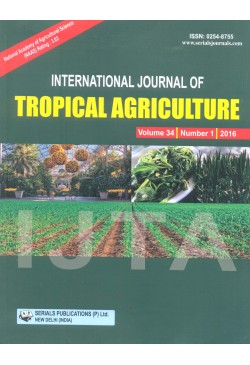
International Journal of Tropical Agriculture
Frequency :Quarterly
ISSN :0254-8755
Peer Reviewed Journal
Frequency :Quarterly
ISSN :0254-8755
Peer Reviewed Journal
Response of Foliar Feeding of Nutrients and different level of Pruning Intensities on Physical attributes of Guava (Psidium guajava L.) c v.Allahabad Safeda
The experiment was conducted on nine year old well-established guava orchard planted at 3.0 × 3.0 m spacing to study the response of foliar feeding of nutrients and pruning intensities on the physical parameters of guava (Psidium guajava L.) cv. Allahabad Safeda during 2022-23 and 2023-24 at Horticultural orchard, Powarkheda,Narmadapuram under the Department of Horticulture, College of Agriculture, JNKVV Jabalpur (M.P.). The experiment was laid out in Factorial Randomized Block Design (FRBD) replicated three times. The treatment consist of two factor (A) three pruning levels, i.e., No pruning (P0), pruning at 25cm shoot from tip (P1), pruning at 50cm shoot from tip (P2) and (B) thirteen level of nutrients No- Control, N1-Urea @ 2%, N2- Urea @ 3%, N3-Nano urea @ 0.2% N4- Nano urea @0.3%,N5 –Zinc @ 0.4%,N6- Zinc @ 0.6%,N7- Nano zinc @ 0.04%,N8-Nano zinc @ 0.06%, N9- Iron @ 0.3%,N10-Iron @ 0.5%,N11-Nano iron @ 0.03%,N12-Nano iron @0.5%. The result revealed that the maximum fruit length (6.44cm), fruit width (6.84 cm), fruit volume (142.72ml), pulp weight (150.19g) and specific gravity (1.020) were recorded in P2 (pruning 50cm shoot from tip). While, the minimum was observed under treatment N0 (no pruning). With respect of foliar application of nutrients, the highest fruit length (6.35cm), fruit width (6.70 cm), fruit volume (144.51ml), pulp weight (152.91g) and specific gravity (1.027) were observed under treatment N2 (3% urea) and lowest was found in N0 (control). Among the treatment combination, in P2N2 (Pruning at 50cm shoot from tip + Urea @ 3%) was found superior with respect of the maximum fruit length (6.67cm), fruit width (7.07 cm), fruit volume (151.58ml), and pulp weight (163.15g) and the minimum was recorded in control.
Keywords: pruning intensity, nutrients, guava and physical parameters.
Mechanical Operation Assessment of Maize Crop using CUSUM Chart
Understanding the operational quality of maize harvesters offers valuable insights for management to optimize resource performance while minimizing costs. This study aimed to assess the mechanized maize harvesting process using the CUSUM chart across different plot configurations. Treatments were based on existing plot shapes within the study area, categorized as either irregular or rectangular. Results indicated that the CUSUM control chart effectively identified process instabilities and contributed to maintaining operational quality.
Keywords: Grain harvester, CUSUM, machine performance.
Trend Analysis for Rubber Monthly Production and its Instability in India
This study will indubitably benefit the farmers, policymakers and stakeholders by delivering accurate forecast information of India.One essential method for locating trends, changes, and patterns in big data sets over a given time frame is trend analysis. Organizations can identify new opportunities, predict future events, and make well-informed strategic decisions by looking at historical data. Knowing trends offers important insights into consumer behavior, market dynamics, and industry changes in a variety of domains, from marketing and finance to technology and healthcare. This analytical method improves competitive advantage, optimizes resource allocation, and aids in change prediction. Trend analysis is a potent tool for anticipating and navigating future issues in a fast changing environment.Trend analysis and instability we are carried out monthly Rubber production data from 1990-2021 this trend model we are selected on the basis of minimum standard error, Significance ,b1,b2 and maximum R2 further more the instability research related that will India had overall low instability in the term of production period in 1990 to 2021.This research will add in formulating effective policies regarding Rubber production.
Keyword: Rubber Production ,Trend ,Instability, Descriptive Statistics.
Bio-Efficacy of Chlorefluazuron 5.4% EC Against POD Borer (Helicoverpa Armigera) Chickpea
The field efficacy of Chlorfluazuron 5.4 % EC in three doses i.e. 1500, 2000 and 2500 ml/ha was evaluated along with Quinalphos 25% EC @ 1000 ml/ha, Lambda-cyhalothrin 5% EC @ 500 ml/ha and Novaluron 10% EC @ 750 ml/ha under field conditions against pod borer (Helicoverpa armigera) during Rabi 2018-19 and Rabi 2019-20. During Rabi 2018-19, Minimum larval population of H. armigera (0.60 larvae/plant) after 14 days after second spray was found in the higher dose of Chlorfluazuron 5.4 % EC i.e. 2500 ml/ha followed by 2000 ml/ha (0.87 larvae/plant). Maximum grain yield (18.25 q/ha) was recorded in the treatment of Chlorfluazuron 5.4 % EC @ 2500 followed by 17.06 q/ha in Chlorfluazuron 5.4 % EC @ 2000 as compared to 12.30 q/ha in control. Same trend was also observed during Rabi 2019-20. On the basis of pod borer population and grain yield data, both doses were statistically at par with each other. Therefore, application of Chlorfluazuron 5.4 % EC @ 2000 was the effective against gram pod borer in chickpea.
Keywords: Chickpea, Chlorfluazuron, Gram pod borer, Bio-efficacy, Grain yield.
Association and Path Coefficint Analysis for Yield and Yield Attributes in Rice (Oryza sativa L.)
The experiment was carried out in the instructional farm of the College of Agriculture in Rewa, Madhya Pradesh. The crosses were carried out in a diallel fashion, excluding reciprocal crosses, with 10 parents and 45 hybrids. These were assessed for “Association and Path Coefficient Analysis in Rice (Oryza sativa L.)” in a randomized block design (RBD) with three replications during kharif 2019. The grain yield per plant exhibited a highly significant positive phenotypic correlation with biological yield per plant, followed by panicle weight, number of filled grains per panicle, number of effective tillers per plant, total tillers per plant, panicle length, number of grains per panicle, and days to maturity. The biological yield per plant has the most significant positive effect on grain yield, followed by the number of filled grains per plant, panicle weight, number of effective tillers per plant, test weight, panicle length, number of tillers per plant, days to maturity, and days to 50% flowering. Hence, these characters might require more attention in the selection of desirable genotypes to achieve higher grain yields of rice.
Keywords: Diallel, Association, Path coefficient, phenotypic correlation, grain yield
Microbial Potential in Heavy Metal Remediation a Systematic Approach
The increasing population has strengthened the food demand and consequently leading to extensive agricultural practices that contribute to heavy metal contamination. Industrialization, mining, and anthropogenic activities have significantly elevated heavy metal concentrations in terrestrial and aquatic environments. Heavy metals such as cadmium, lead, arsenic, copper, and mercury persist in soils for longer time periods and bio-accumulate through food chain and adversely affecting the crop yield and food quality. Heavy metal contamination also affects the soil microbial communities likes diversity, metabolic processes, and biomass production. Several microbial strains, including Pseudomonas aeruginosa, Bacillus amyloliquefaciens, Aspergillus niger, and Spirulina platensis, have shown important bioremediation potential. Bioremediation is cost-effective, eco-friendly alternative to traditional remediation practices. However, its efficiency is influenced by environmental factors such as microbial strain specificity, and metal bioavailability. A synergistic approach integrating microbial and phytoremediation strategies may enhance heavy metal detoxification.
Keywords: Heavy metal, bioaccumulation, Microbial bioremediation, Toxicity
Engineering Properties of Finger Millet
Engineering properties of grain play a vital role in designing crop production, material handling and processing equipment. A study was conducted to determine the engineering properties of finger millet at different moisture content in the range of 6.0 - 17.5% (w.b.). In this moisture range, the sphericity of finger millet increased while bulk density, true density and porosity decreased with an increase in moisture content. The values for sphericity, angle of repose & porosity for finger millet varied from 0.540 to 0.668, 21.344 to 23.517 degrees, and 40.4 to 37.4 respectively. The angle of repose also increased with an increase in moisture content. Bulk density and true density for finger millet varied from 795 kg/m3 to 755 kg/m3.
Keywords: Engineering properties, Finger millet, moisture content, surface area, volume, true density, bulk density, porosity, angle of repose, sphericity