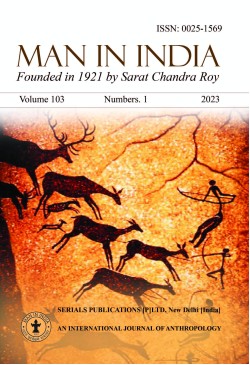
Man in India
Frequency :Quarterly
ISSN :0025-1569
Peer Reviewed Journal
Frequency :Quarterly
ISSN :0025-1569
Peer Reviewed Journal
AESTHETICS OF HUNTING: A NEURO-AESTHETICAL STUDY OF A MESOLITHIC ROCK-ART OF BISON-HUNTING AT BHIMBETKA
Archaeological sites with cave-paintings offer a glimpse of Prehistoric past. Such paintings usually depict a range of activities, from ritual dancing to communal feasting, with each painting performing either an apotropaic or sympathetic function in a magical-cultural context, as gleaned from specificity and selectivity in the choice of locations, treatment of surfaces, delineation of contours etc. The deep involvement of intentionality and deliberation entails aesthetical qualification as well. In this paper, an attempt shall be made to apply principles of neuro-aesthetics to Mesolithic rock-painting of a Bison-hunt, and dive into cognitive frameworks of prehistoric populace to glean their milieu and mechanisms, in order to develop a wider discourse with purpose, ‘philosophy’ and aesthetics of prehistoric-art. This artistic hunt shall be minutely analyzed both contextually and from a neuro-aesthetic perspective, which would aid our understanding of deeper aesthetic-artistic prospects of hunt concerned herein, but would also help in gleaning interesting data about inter-community interactions and artistic exchange of ideas amongst different spatially and chronologically proximal Mesolithic social-groups. Also, emphasis shall be made on the need to broaden the horizons of Rock-art analysis, where Neuro-aesthetics can play a critical role.
A SOCIO-ECONOMIC UNDERSTANDING OF THE GONDHALI COMMUNITY OF CENTRAL INDIA
Gondhali is one of the well-known communities in central India. They are mainly popular for their traditional dance (folk dance) form i.e., ‘Gondhal dance’. In the present-day scenario, the life of the folk dancers (performing artists) changes gradually. In many situations, it is found that due to the lack of interest of upcoming generations, many arts are on the verge of abolition. So, it is important to study a community like Gondhali (a community of folk dancers) to understand various dimensions of their society, economy, livelihood etc. So, the current study is an ethnographic investigation of the Gondhali (widely known for their traditional dance) community who inhabit several states in India's Central region. This study examines various facets of the demographic data, means of subsistence, social organization and structure, and religious practices of this population through empirical observations. The implementation of government-led development initiatives has resulted in significant transformations in the populace's lifestyle. The present paper mainly focuses on the social, economic and other perspectives that are essential for their survival.
MATERIAL CULTURE OF CHUKTIA BHUNJIA TRIBES OF ODISHA : AN ANTHROPOLOGICAL INTERPRETATION
This present paper documents the material culture of Chuktia Bhunjia tribe inhabiting interior to Sunabeda wildlife sanctuary of Odisha, India. Data collected using ethnographic techniques- formal interview and observation- reveal that the material culture of this little-known tribal group is shaped by ecology. Yet, the role of neighboring group especially iron melter (lohra) and basketry makers (Paharia) cannot be sidelined who supply them material artifacts for diverse use. Each material object they use portrays a distinctiveness whose value and meaning pass back and forth in everyday life of the Chuktia Bhunjia. Each cultural practice they have adopted is negotiated with specific material artifacts and is associated with various form of ritual, beliefs and value including the idea of gender and pollution. The material culture of this tribe is found to revolve around the idea of culture and knowledge, idea of utility and idea of relationship with knowledge. The material being freely available or at minimal rate, it increases their work efficiency and makes them economical. Yet, many forms of their material culture are getting transform because of a number of factors including enculturation, influence of market and state intervention and therefore, affecting their community identity.
JOINT FOREST MANAGEMENT IN MEGHALAYA: A STUDY OF COMMUNITY DEVELOPMENT AND PARTICIPATION
Human life depends on forests, which are essential natural resources, especially for the communities that live there and nearby. Numerous plant and animal species act as a haven for biodiversity by providing resources like non timber forest products, herbs, and other resources for clothing and shelter; this abundant biodiversity makes ecosystems more resilient and sustains livelihoods. Joint Forest Management (JFM) contributes significantly to forest protection and community welfare by engaging the local people in safeguarding and managing the forest resources. Joint Forest Management (JFM) in Meghalaya is an important model of community-based forest management that incorporates traditional ecological wisdom and state-initiated conservation programs. Forests play a critical role in maintaining livelihoods, cultural heritage, and biodiversity, particularly among indigenous groups. This paper examines the operation and impacts of Joint Forest Management (JFM) in Nongwah village, East Khasi Hills of Meghalaya. Drawing from field observations and village narratives, it examines roles and duties undertaken by community agents, impacts of community-managed afforestation, and socio-economic benefits derived from infrastructure development linked to JFM. With this research, the literature is enriched with recording the interface of customary and formal institutions of forest governance. In the process, it addresses an essential lacuna in the forest policy literature in northeast India
BONDA HIGHLANDERS: EXPLORATION INTO THEIR HABITAT AND SOCIAL STRUCTURE
The Bondo Highlanders are known as Bondas in the region and, live in the Bonda Hills of Khairput Block of the Malkangiri District, in two Gram Panchayats, namely Mudulipada and Andrahal, and, one village called Tagabeda of Rasbeda Grampanchayat form the areas of Bonda Hills. The Bonda Hills lie at an average elevation of about 3000 to 4000 feet above sea level. The hilltops, hill slopes and plateaus surrounded by the hills and hill terrains constitute the habitat of Bondas measuring an area of 35910.25 ha. or 35.9 sq.km. The Bonda Hills are full of picturesque natural beauty having a bounty of forest resources. The entire Bonda Hills environment is calm and quiet. The Bondas are one of the thirteen Particularly Vulnerable Tribal Groups (PVTGs) of Odisha State. In this paper, through narratives, the researcher has attempted to reflect ethnographic details about the village settlement, housing pattern and social structure, such as kinship organisation, marriage, divorce, dress and ornaments, food and drinks etc. It also covers briefly their everyday life, including religious beliefs and practices. The data were collected through ethnographic research and the field work was conducted in the Bonda Hills for about a year and a half, i.e., from October 2021 to March 2023
NAVIGATING HEALTH AND ILLNESS AETIOLOGIES AMONG THE FISHING COMMUNITY OF PALAKAYATIPPA IN ANDHRA PRADESH
Health is one of the prioritized aspects for everyone and can be apprehended from different perspectives. These perspectives vary from one perspective to another, drawing attention to analyse the healthcare dimension from the community perspective. The dynamics of the communities concerning health and illness provide an understanding of the status and condition of the experiences and suffering. The article highlights the perception of health, illness, and aetiologies, as well as health determinants and influences on the wellbeing of community members. The article also notes how community members perceive their healthcare and produce their views on the management of healthcare by providing the perception of health and illnesses. Based on these aspects, this article comprehensively explains health and illness aetiologies within the Palli community in Palakayatippa village of Andhra Pradesh. It concentrates on how this fishing community navigates health and illness through personalistic and naturalistic perspectives from individual healthcare. With an ethnographic approach, this work employed qualitative methods to gather data on various local healthcare practices, concerns, and remedies for treating illnesses. The study also explored how community members perceive their healthcare, transitioning from an individualistic to a community-oriented approach. Further, it also emphasizes the influence of occupational health on their daily work performance.
FLEXIBLE BRASS CRAFT TRADITION OF BELLAGUNTHA, DISTRICT GANJAM, ODISHA: AN ANTHROPOLOGICAL ANALYSIS
This is one of the centuries old traditional brass craft of the Kansari community of Bellaguntha, Odisha where a distinct form of bronze products like fish, snakes and prawns etc are prepared from the metal sheet with and traditional processes. Because of its fascinating way of creating new products, it is different from the Dhokra craft. The product of this craft carries a great cultural and ritual value as it is used to develop artefacts for many local festivals, weddings and religious processions. Chisels, hammers and hand drills as well as brass sheets and tin-zinc alloy are used in this traditional fabrication techniques. The division of labour in the craft is similarly gendered, with men predominating in the manufacturing aspect of the craft, while women primarily do the finishing aspect of the craft. Presently, these craftsmen are facing challenges relating to documentation, marketing, sustenance. Efforts are also being made towards getting a Geographical Indication (GI) marking for this skill which would allow for market recognition and benefits as well as recognition. The study addressed the urgency for systematic approaches to reviving and sustaining this craft for future generations. The objectives of the paper are to assess flexible brass crafts, the symbolic and cultural meanings of tools and practice, and the community's socioeconomic issues.
BOOK REVIEW