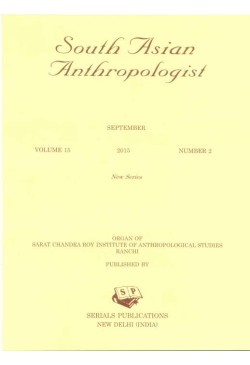
South Asian Anthropologist
Frequency :Bi-Annual
ISSN :0257-7348
Peer Reviewed Journal
Frequency :Bi-Annual
ISSN :0257-7348
Peer Reviewed Journal
Doing Anthropology, Doing Good: An Exploration
Anthropology is the study of human beings in totality. The spirit of
anthropology lies not only in the understanding of people but also towards contributing to
their welfare. Armed with strong theoretical orientation and with emphasis on long-term
intensive fieldwork, anthropology becomes indispensable for apt formulation of plans,
programmes and policies for human welfare. Through thorough ethnographic research, an
anthropologist is able to get the pulse of the ground reality. Development of a people and
amelioration of their problems are the goals of every welfare state. Anthropologists, on
account of their in-depth understanding of people at the grass-roots level, are well equipped
to be a very important part of policy making and implementation. Anthropology has traversed
a long way since colonial times, taking within its hold, new areas of research, and redefining
its own unique features like cultural relativism, embracing the idea of postmodernism while
defending positivism, and bringing the study of all kinds of societies under its focus of
research. Over the years, the USP (unique selling point) of anthropology has become its
action -oriented approach and it is this approach which needs to be taken into consideration
by the stakeholders of development.
Indigenous Perceptions and Practices on Ethno-physiology and Childbirth of the Galos of Arunachal Pradesh
Every ethnic group has its indigenous perception of the physiology and function of the human body. Likewise, the Galos of Arunachal Pradesh have ethnophysiological perceptions on different parts and organs of the human physiology. They also have their traditional indigenous beliefs and practices on conception and pre and post-partum delivery of babies. An attempt is being made to examine the ethno-physiology and childbirth associated with myths, beliefs and practices of the Galo tribe propped with empirical fieldwork data.
Ethno-medicine and Healing Practices by Koya Traditional Healers of Gadchiroli District, Maharashtra
Traditional healers have been using flora- fauna and mantras for healing for many hundreds of years. Traditional healers are those who have received their therapeutic knowledge either through family traditions or through training with another healer. The aim of the study is to document and find out the traditional knowledge of medicinal plants, their uses and the types of diseases treated. The study was conducted among Koya traditional healers in Gadchiroli district, Maharashtra. Snowball sampling method was used for data collection. All the traditional healers belonged to the Koya tribe and had been born and brought up in their respective villages. The traditional healers have been practising for years and have learnt their knowledge from their ancestors or through family members. It can be concluded that the role of traditional healers in treating various diseases is crucial among the tribes. They use many different forest plants, weeds, flowers, seeds and barks in their traditional treatment. Most of the preparations are taken orally and applied to the diseases. In the area studied, many people still believe in the traditional knowledge and remedies that play an important role in the lives of these communities.
A Study of Nutritional Status among the Adolescents of the Kotia Tribe in Visakhapatnam Agency, Andhra Pradesh
The present cross-sectional research study attempts to comprehend physical growth based on height and weight, whereas nutritional status based on BMI following classification of World Health Organization (WHO). Using conventional anthropometric method, the physical growth and nutritional status of 380 boys and 366 girls aged between 10 to 18 years was determined. All the data is evaluated statistically to find out the mean, standard deviation, two tail ‘t’ test and x2 test by using excel and MINITAB software. The data of present study reveals that the average height and weight of both boys and girls increase as the age progressed. In all age groups it is notable that the both boys’ and girls’ average height and weight is lower than the WHO/NCHS standards. The overall prevalence of underweight is 53.21percent and normal weight is 45.04 percent for both boys and girls. In depth research studies and rigorous health interventions are required to discourse these problems.
Growth and Nutritional Status of Males (11-20 years) among the Konyak Naga Tribe of the District Mon, Nagaland
Growth is the process by which an organism develops physically, mentally, or emotionally. Over time, it entails escalating in size, complexity, and capabilities. Height, weight are just a few of the physical changes that occur in individuals from birth to adulthood that are referred as growth. The Objective of this study was to assess the growth among a tribal group of Nagaland. Hence, this cross-sectional study was carried out among the Konyak Naga boys of age group 11-20 years. The findings are based on primary data collected from a total of 141 respondents during April 2023 from schools of Mon town and surrounding villages of the district Mon of Nagaland. Measurements viz. height, bodyweight were taken with the help of anthropometric rod and weighing machine. The findings reveal that the Konyak Naga were lagging behind in growth of stature and bodyweight than NCHS reference data especially during 11 to 19 years of age. The cohort of 17 years were found taller as compared to the cohort of 18 to 20 year indicates stunting in that cohort.
Digital Mediation of Political Activism as a Cause of Change in Policy Making: Anthropological Perspective
Politics and power dynamics devise the structural core of an agencyexercising society. The relationship between the media and the audience has undergone a substantive change from its prior form, where a limited number of individuals exercised their agency to propagate elitist narratives and discourses via social power. The knowledgeseeking society was a mere passive consumer of information and had a limited voice in broadcasted content. The emergence of cyberspace introduced a new technological commodity constituting a part of the existential identity of people. Symbolically synonymous with their physical habitat, this technologically deterministic system created dual-world citizenship, characterized by the term netizens for humans in the cyber world. The binary divide of existence has engendered a metamorphic change in the Foucauldaian power dynamics because of the existential duality of people in the ‘virtual’ (social networking sites) and the ‘physical’ world. Exploring from an anthropological perspective, this paper is a novel attempt in bridging the gap between the cyber world and policy making. Employing an extended case study method in cyber-ethnographic space, the study probes the intimidation of social networking sites in the imponderabilia of everyday life of Indian people in the cases of cyber activist movements -Section 377 abolition and #MeTooIndia movement. These two movements witnessed an overwhelming participation from heterogeneous rungs of society and compelled the bureaucratic policymakers to introduce necessary ramifications for bringing a colossal social change, reflecting how an innocuous lounge activity transform into a full-fledged activist movement and shape social policies
An Ethno-Architectural Documentation of Alteration in Settlement Pattern among the Hill Korwa of Chhattisgarh
The present study was undertaken to access the indigenous knowledge about Ethno-architecture and develops the theoretical frame on housing pattern among the Hill Korwa tribe of Korba district, Chhattisgarh. The research was focused and based on anthropological and ecological perspective. The ecological perspective deals with the use of local available material and adaptation with environmental condition. Finding of present study shows that there are four types of houses have been found among Hill Korwa tribe, namely Jhala 1 (Timber shelter), Jhala 2 (Timber shelter with mud plaster on walls), Jhala 3 (Timber shelter and its roof covered with shards (Khapra) or mud flakes) and Chadkhodi (Timber shelter with porch). Animal shelters were also found associated with residential shelter, four types of animal shelter were found, namely Cherimacha (goat shelter), Kukrigodadri (hen shelter), Suamacha (pig shelter) and Bailamacha (cow shelter). However, it may be inferred after assessing variation in housing pattern among the study group was due to cultural diffusion. Environmental changes and ecological depletion or resource scarcity and government policies in study area were analyzed as change agencies in present study.
Preserving Traditional Skills and Dance Forms as Cultural Treasures: Reflections from Mayurbhnaj District of Odisha
Traditional skills, games and oral performances are integral components with rich cultural heritage of the indigenous communities. These practices have immense values in the individuals and community life. They are the binding forces among people and their society. The present paper focuses on the innovative attempts made by the tribal communities of Mayurbhanj district in the state of Odisha to preserve the dying intangible cultural heritage. More than 20 sports and games events were systematically observed to understand the details of events and the types of prizes given to the best performances. Apart from that the associated activities at the event sites were also observed. For example, cock fight, selling and buying of different products, selling rice beer etc were very closely observed. Looking at the current scenario, traditional cultural heritage of these tribes are rapidly declining. Atu Isport, the annual village event in the district of Mayurbhanj is a unique innovative initiative organized by the tribal communities during the month of January to April every year. These annual events are blending of modern athletic events and traditional dance performances with traditional knowledge and skill tests. The event creates a social space in which different socio-cultural behavior are expressed by the participants which strengthens the intra-village and inter-village unity and solidarity at the regional level. All these intangible activities, practices need to be preserved, and promoted.
Cultural Management of the Natural Resources in a Changing Perspective: A Study among the Choukhutia Bhunjia Tribe in Gariaband District, Chhattisgarh
The concept of culture as understood in anthropology is concerned with both material and non-material aspects of human society. It acts as the centripetal force to influence the life and living of the people. The dynamic aspects of a culture are influenced by both internal changes in the command over resource base of the community and external interventions made by outside forces. In this process the pattern of continuity
and change is largely influenced by the use and control over the management of various core values of a culture and natural resources base of a community. Keeping this in mind, an attempt is made to document the cultural management of natural resources in a changing perspective among the Choukhutia Bhunjia Tribe of Gariaband district of Chhattisgarh State. The paper is based on long field work in eight Choukhutia Bhunjia dominated villages, has attempted to understand the symbiotic relations maintained between the ecology and habitat with cultural resources of the community. The paper justifies that the ecology influences the habitat of the Choukhutia Bhunjias and their cultural resources in spite of various development interventions carried out by outside agencies in the region.
Before Society Gets Them: Fear of Failure among Students in India
Student suicide in India is a pressing concern that requires immediate action. As students represent the future of the nation, the increasing trend of suicides among students in both school and higher education levels signifies a potential decline in the future development of the country. The primary objective of the current research article is to explore the rising suicide rates among students attributed to the fear of failure in examinations. It emphasises the profound influence of societal stigmatization surrounding the concept of failure, which adversely affects the mental well-being of students and ultimately drives them to take their own lives
Navigating Fieldwork Challenges: An Anthropological Exploration of the Jaunsari Tribe of Uttarakhand
This present paper explores the fieldwork challenges encountered while studying among the Jaunsari tribe of Uttarakhand from an anthropological standpoint. The Jaunsari tribe, which is mainly resides in the Jaunsar-Bawar area of the Dehradun district, presents a distinct, intricate, and diverse social and cultural structure. However, conducting fieldwork in this remote area presents a logistical challenge due to its remote and hilly areas, which is often affected by landslides and poor road conditions, particularly during the monsoon season. Furthermore, there are significant challenges for the data collection and interactions with the people due to the insufficient infrastructure, which includes poor connectivity to the internet, electricity, and facilities for health care and hospitals. This present research paper employs a multidisciplinary approach, including participant observation, interviews, surveys, and fingerprint collection of the Jaunsari tribe. The study highlights the significance of comprehending regional customs and traditions in order to carry out respectful and successful research. This paper intends to add to the broader discussion about anthropological methodologies and the challenges of exploring indigenous communities by providing a thorough analysis of field experiences.
Decolonisation Trends in Indian Anthropology
This paper explored the trends of decolonised anthropology in India with two remarkable examples from the works of H.C.Chakladar and T.C.Das. Our study clearly revealed that both Chakladar and Das among others made bold attempts to develop an Indian tradition in the practice of anthropology even during the colonial period.
Book Reviews