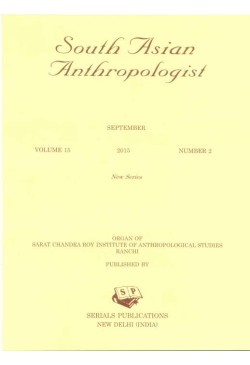
South Asian Anthropologist
Frequency :Bi-Annual
ISSN :0257-7348
Peer Reviewed Journal
Frequency :Bi-Annual
ISSN :0257-7348
Peer Reviewed Journal
Interdependence of Anthropology and Interior Design: An Exploratory Study
Design anthropology is an increasingly influential and critical discipline that enriches the understanding of society. As professionally trained designers position themselves as catalysts to social change, they bring with them efficiency in process, sophisticated skills and interdisciplinary collaborations. This paper sets out to explore the connection that has developed between interior design and anthropology in the field of research, by outlining the emergent discourse. It concludes with the identification of interior anthropology as a new social science. This paper aims to look at the crossroads where anthropology and interior design meet and decide to create a new path. Leaning on each other to make their disciplines better and creating something new and unique in the process.
Migration and Livelihood in the Context of Recurrent Flooding in Bahraich District of Eastern Uttar Pradesh
People displaced due to disasters do not find clear-cut mechanisms that can protect their rights. Response of the state towards displaced people tend to be adhoc in nature and this opens up space for power and politics to negotiate with rights of these Internally Displaced Persons (IDPs). In the context of India, recurrent disasters displace lakhs of people every year. In Uttar Pradesh, West Bengal and Orissa almost 10 million people get displaced due to floods every year. Migration is mostly dependent on the search of better alternatives of livelihood and survival. If we talk in the context of disasters, migration has taken place to a very large extent. The present paper discusses the issue of migration in the context of recurrent flooding in the district of Bharaich of Eastern Uttar Pradesh in India. The paper discusses various causes and consequences of migration due to floods and how this has an impact over the idea of sustainable livelihood of people.
KEYWORDS: Disasters. Recurrent flooding. Migration. Sustainable livelihood. Bahraich. Uttar Pradesh.
Tolan? Biy?: A Rite of Passage to Mark Menarche in Assam
The article depicts the ground realities of how Assamese celebrate menarche and also the ritual drama associated with it. It emphasizes the symbolic representation of coming of age as practiced in Assam while referring to mythology as a guiding force in their well-being. It also reflects the socio-cultural and religious matrix that implies the puberty rite, locally known as Tolan? Biy?. The fieldwork was conducted among the Assamese Brahmin community in Darrang district, Assam, from February 2021 to August 2021 and from October 2021 to January 2022. The study was conducted to portray through an anthropological lens about the regional variation of the rites practiced among diverse regions in Assam.
Health Status of the Pando Tribe in Surguja District of Chhattisgarh: A Micro Study of the Accessibility and Utilization
The life and livelihood of tribal people in Chhattisgarh is substantially influenced by the geo-physical and age-old socio-cultural institutions they live in. Under the situation the development of tribal people who almost share 32 per cent of the total state population very well determines the development pattern of the state. The present research has reflected various facets of health status of the Pando tribe of Chhattisgarh. More particularly it explores the accessibility and utilization of the health services by the Pandos. Anthropological study methods and techniques were adopted to collect primary data during the period 2018-19. The paper tries to quantify the accessibility of the Pando tribal people to the health services. More particularly it analyses their disease profile, sources of treatment, expenditure pattern made to avail health services, and also documented their perception and attitude towards modern treatment. While quantifying the qualitative responses of the Pando’s, the study attempted to find out the gaps in and barriers to health service provisions. The study argues that why a community based decentralized health service delivery system based on empowerment of the tribal people is yet to be in operation? Why the tribal people as human endowment is not treated as a form of productive capital and the health services provided by the State do not treat tribal people as productive tool?
Babasaheb Dr. B. R Ambedkar and His Relevance in Anthropology: Caste and Untouchability Specific Analysis
Coming of an untouchable community, Babasaheb Dr. B.R. Ambedkar, well known as icon of human rights movement, initiated several social reformative movements to bring about social change. He highlighted social inequality, in Hindu social order and caste system from historical and anthropological point of view and produced an excellent anthropological chronicle. Ambedkar’s unique analysis of untouchability comes from his years of experience as a student at Columbia University. His famous research paper presented in the conference at the university in 1916 inspired several anthropologists for further study on caste system in India, in which he found out the origin of the caste system and rigid endogamy is major cause of jati formation as a closed system. Due to imposition of Brahminical administration like endogamy, child marriage, restriction on widows and liberalization of widower, the caste formation took place. Attempt has been made in this paper showing contribution and directions of Dr. Ambedkar in conformity with anthropology, with special emphasis on his novel thoughts on untouchability, caste system and on the Sudra.
KEYWORDS: Anthropology ,Caste,Untouchability,Shudra,Indian anthropology
Understanding Social, Cultural and Political Determinants of Maternal and Child Health: A Medical Anthropological Study of the Kondareddis of East Godavari District, Andhra Pradesh
Understanding maternal and child health from critical medical anthropological perspective reveals that maternal and child health (MCH) status is a result of complex interplay of social, cultural and political factors. This paper aims to explain the role of social, cultural and political factors in determining the MCH status among the Kondareddis. Fieldwork was undertaken for a period of 25 days among the Kondareddis of Busigudem village, East Godavari district, Andhra Pradesh. The methods of participant observation, schedules, in-depth interviews and case studies were employed. The data obtained were analysed using content-analysis method. The results revealed that social and cultural elements influence the reproductive behaviour and health care practices. There exists a trend towards maximization of reproductive functions. However, this trend runs counter to the health of the woman. In addition to the social and cultural factors, the article discusses the negative impact of state interventions in the form of development programmes and welfare schemes on the MCH Status. Results indicate the need to establish vertical links between factors operating at micro level to larger social, cultural and political forces operating at macro level.
Trends and Determinants of Blood Pressure and its Association with Clusters and Sub-Clusters of Menopausal Symptoms among Rural Women of Kanpur, Uttar Pradesh
The present study tends to observe the trends and determinants of blood pressure and its association with clusters and sub-clusters of menopausal symptoms among rural women of Uttar Pradesh. The study consisted of 351 women from 35 to 55 years of age from rural area of Kanpur (India). The menopausal symptoms were evaluated using the Greene Climacteric Scale and JNC VII criteria was used to assess the blood pressure status of the participants. Analysis of data revealed that the mean scores of psychological, anxiety, depression, somatic and loss of interest in sex menopausal symptoms were significantly higher among hypertensive women as compared to their normotensive counterparts except vasomotor symptoms. In multivariate regression analysis, women with age above 45 years, lower middle class, postmenopausal status, osteoporosis and overweight were shown to be possible risk factors of occurrence of hypertension. Menopausal transition was one of the important determinants of developing hypertension with the perimenopausal women had 1.2 folds and postmenopausal women had 3.9 folds higher risk of developing hypertension than their premenopausal counterparts.
KEYWORDS: Hypertension. Women’s health. Menopause. Menopausal symptoms. Rural women. Kanpur district. Uttar Pradesh
The New Land Acquisition Law, Reforms and Local Self- Government: The West Bengal Scenario
The new land acquisition law enacted in 2013 offered immense scope for the sociologists and social anthropologists to conduct assessment of this law in the context of the role of the local self-governments (Panchayat or Gram Sabha). An attempt has been made in this article to make such an assessment by taking the case of the West Bengal state in India from a historical perspective. The study revealed the shortcomings of the new law in terms of the definition of the ‘Appropriate Government’ and its similarity with the colonial law in treating the local self-governments.
KEYWORDS: Land acquisition. Local Self-Government. Panchayat. West Bengal.
Health Status of Traffic Police Personnel of Nagpur City in Maharashtra
Traffic police personnel men are people with outdoor occupations in urban areas. Unfortunately, traffic police personnel have a risk of certain diseases related to their occupation and lifestyle. The place of work is a significant part of a man's working environment as he spends at least 8 hours a day at work. That’s why health is affected by the working environment to a large extent. The working environment constitutes an essential part of man’s bio-social environment. So, health to a large extent, is affected by working conditions. The research paper aims to assess the health status of the traffic police personnel of Nagpur city in Maharashtra. The study was conducted among the Traffic police personnel of the Nagpur city of Vidarbha region in Maharashtra. A non-random sampling technique was used to select 252 police personnel out of 644 traffic police personnel of Nagpur city. The health status of traffic police personnel was assessed by using a structured interview schedule and by conducting anthropometric measurements and clinical examination of the subject. The present study revealed a significant difference in age and sex-wise distribution of body mass index (BMI) among males and females (p<0.001). Out of the total sample (252) selected for the study, 59.5% of police personnel suffered from muscular skeleton disorder, and 17.4 % had lung function problems. 5.5 % of police personnel suffered from heartrelated problems, hypertension was observed 2.7 %, and diabetes in 7.5 % of police personnel. 18.1 % of personnel were obese, and overweight in about 52.3 % of traffic police personnel.
KEYWORDS: Traffic police. Nagpur. Occupational disease. Musculoskeletal disorder. Respiratory problem. Skin disease
An Exploration of Kinner Akhada and the Process of its Assimilation into Akhada System during Kumbha Mela at Prayagraj
Kumbha mela is the most significant religious gathering of Hindu pilgrims in India. Based on gender, the pilgrims are constituted of both males and females. However, in 2019, Kinners (transgenders) became the central theme of the Kumbha at Prayagraj. Religious assimilation of Kinner Akhada has unraveled the new gender perspective of Kumbha mela. During the Kumbha, Kinners could convince the traditional sadhu samaj (ascetic society) that they were also a part of this phenomenal event. Behavioural shift and claim of being a demigod in response to demand for entitlement of Mahamandleshwar to the Kinners was imperative in the process of assimilation. This event emphasizes a functional aspect of religion. The paper is based on ethnographic fieldwork conducted during the Kumbha (2019) and Maghmela (2020, 2022) events at Prayagraj. The explorations made in this paper attempts to understand process of bridging the preexisting dichotomy between Kinner and Kumbha.
KEYWORDS: Kinner Akhada. Kumbha mela. Transgender. Sadhu samaj. Mahamandelshwar. Assimilation. Akhada.
An Ethnomedicinal Study of ‘Munga’ (Moringa oleifera) with its Special Reference to the Pandemic among the Santal of Jharkhand
A balanced diet can help to reach and maintain a healthy lifestyle. Santal uses(munga) Moringa oleifera in their daily diet. Moringa oleifera.Lam is a wellknown medicinal plant and a great source of medicinal food for Santal. The present study was conducted in the Dumka district of Jharkhand to illuminate the widespread usage of Moringa oleifera among Santal. The plant possesses minerals, vitamins, amino acids, beta carotene and protein and is rich in antioxidants and vitamin C. The decoction of Moringa leaves was taken daily on an empty stomach which helped Santal people boost their immunity and fight against coronavirus during the pandemic. Nutrients found in moringa help regulate blood pressure and diabetes. This study was fruitful in understanding the traditional knowledge of Santal about how they use Moringa as a source of medicinal food in their day-to-day life. Elderly women were interviewed to understand the recipe for moringa leaves that Santal people consumed. The research study illuminates the various uses of Moringa oleifera at different levels in Santal culture, and it recommends the benefits of moringa to the general public. This can further help the WHO and AYUSH promote and make public awareness about the Moringa plant’s health benefits. Data collection has been done with primary sources such as interviews, observation and secondary sources such as journals.
KEYWORDS: Moringa oleifera. Santal. Dumka. Jharkhand. Pandemic. Medicinal Food. Traditional Knowledge. WHO. AYUSH.